
 EN
EN

What Are the Common Dimensions of Highway and Railway Bridge Noise Barrier Panels?
On highway and high-speed railway bridges, we often see rows of neatly installed noise barriers. These barriers are assembled from individual “unit panels,” and their dimensions directly affect noise reduction performance, structural safety, and project cost during both design and installation.
So, what are the common dimensions of highway bridge noise barrier panels?
A Common Question: There Is No Absolute “Standard Size”
It should be noted that there is no single universal size for highway and railway bridge noise barriers. Relevant industry standards provide guidance for panel dimensions, but the final size is usually adjusted according to specific project requirements. Common specifications include 1960×500×140 mm, 1960×500×117 mm, and 1960×450×140 mm. Overall, the dimensions of unit panels are mainly concentrated in the following aspects.
I. Panel Length: 2000 mm Is Common and Can Be Customized
The length of the unit panel is usually consistent with the spacing between support columns. In current railway engineering projects, a 2.0-meter column spacing is the most common, so 2000 mm long panels are widely used.
Under different design standards and project requirements, other spacing options are also available. For example, some highway bridge projects use 1960 mm long panels while maintaining a 2-meter column spacing to leave installation gaps. Intercity rail projects may use 3960 mm long panels with column spacing increased to 4000 mm to improve installation efficiency. In addition, railway bridges may also use panel lengths such as 1260 mm and 1660 mm to meet specific on-site requirements.
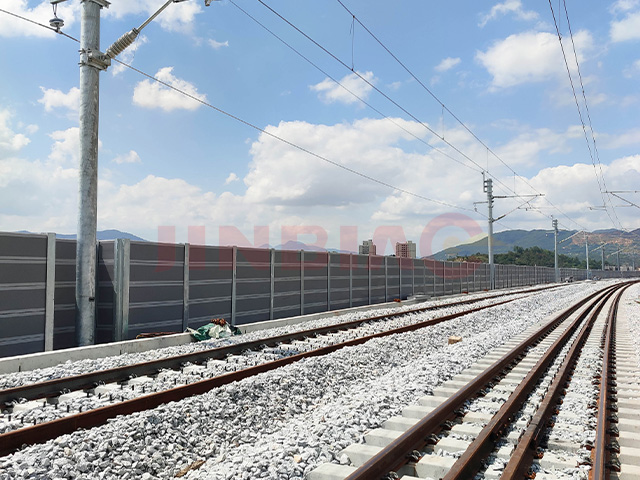
II. Panel Width: Modular Design with 500 mm as the Mainstream
The width of the unit panel (vertical direction) is also designed based on a modular concept. The most commonly used width is 500 mm.
A 500 mm wide panel is convenient for transportation, installation, maintenance, and replacement, while also allowing flexible combinations to achieve different overall barrier heights.
In actual engineering projects, 500 mm remains the most widely used width specification.
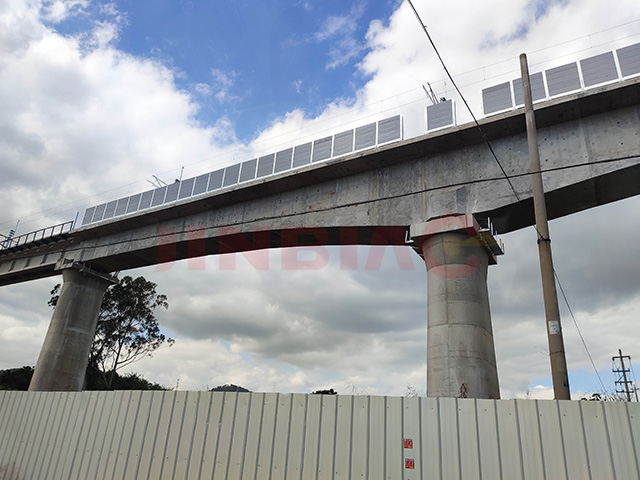
III. Panel Thickness: 80–140 mm as the Main Range
Panel thickness is one of the key parameters affecting noise reduction performance, while also influencing structural weight and installation difficulty.
The mainstream thickness range is currently 80–140 mm. Railway projects generally require thicker panels, with 140 mm being common. Highway bridge noise barriers are more flexible, with 80 mm and 100 mm being frequently used specifications suitable for standard noise reduction requirements. These thinner panels are lighter in weight and place less load on bridge structures.
IV. Total Barrier Height: Adjustable from 2 m to 5 m
After assembly, the total design height of the noise barrier generally ranges from 2000 mm to 5000 mm. Common heights include 2000 mm, 3000 mm, 4000 mm, and 5000 mm.
Urban road bridge projects may further divide the effective height into multiple specifications such as 2.0 m, 2.5 m, 3.0 m, 3.5 m, and 4.0 m. In practical engineering applications, the final design height depends on the noise control requirements and environmental assessment results of sensitive areas along the route.
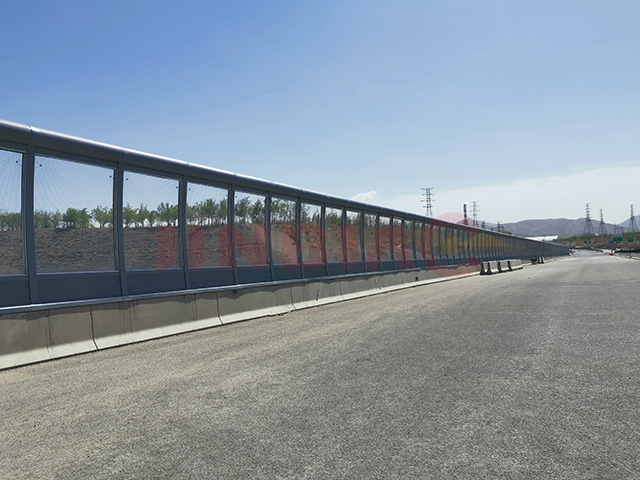
V. Matching Column Specifications
The installation of noise barrier unit panels relies on H-section steel support columns. Common column specifications include 100×100×6×8, 125×125×6.5×9, and 150×150×6.5×9.
Column height and spacing are closely related to panel dimensions — column spacing determines the panel length, while column height determines the total assembled height of the noise barrier.
Optional Non-Standard Customization
The dimensions above are common industry standards, but noise barriers are often customized for specific projects. Whether you require 1960 mm or 2000 mm lengths, 500 mm or 1000 mm widths, or 80 mm or 140 mm thicknesses, all specifications can be customized according to customer requirements.
If you have a specific project requirement or need more detailed technical parameters, please feel free to contact us for professional selection recommendations.