
 EN
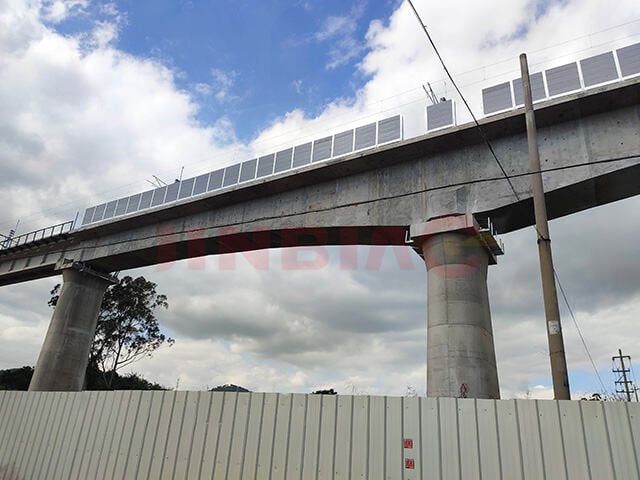
Why the specification matters more than the product list
A motorway noise barrier is rarely bought as a catalogue item. It is procured against a performance specification, built along a live carriageway, and expected to keep working through decades of traffic, weather and de-icing salt. When a project goes wrong, the cause is usually not the panel but a gap in the motorway noise barrier specification: an acoustic target that was not tied to a receiver position, a post spacing copied from another scheme, or a foundation detail that ignored a drainage run.
This guide works through the clauses a motorway noise barrier specification needs, in the order a designer or procurement team makes the decisions. It is not a catalogue of panel types — those are covered in our introduction to highway noise barrier types and materials.
Step 1: Fix the acoustic target first
Every later decision follows from the acoustic target: height, panel build, post spacing, budget. Set it by the acoustic consultant or highway authority against specific receptor positions, not against a generic product rating.
Insertion loss and absorption are separate requirements
Insertion loss describes how much a motorway noise barrier reduces sound at a receiver compared with the same site without it. Absorption describes how much sound energy the surface takes in rather than reflecting. A barrier can perform well on one and poorly on the other. On an open embankment with receivers on one side, reflection is rarely a problem. In a cutting, between carriageways, or along a corridor with buildings close on both sides, reflected energy builds up and an absorptive face becomes part of the acoustic requirement rather than an upgrade.
Write the two as separate clauses, or a supplier can meet the insertion loss figure with a reflective panel and still miss the intent of the scheme.
State the method and the reference positions
Name the calculation method, receptor coordinates, traffic assumptions and design year. If the scheme is assessed in phases, say which phase the motorway noise barrier is sized for. A reduction figure quoted without these inputs cannot be verified afterwards.
Step 2: Define geometry that matches the site
Height follows from the target and the receiver
Height of a motorway noise barrier is a function of source-to-receiver geometry, distance to the barrier and the target reduction. Two schemes with the same panels can need different heights because receivers sit at different elevations. Fix the height per section and show where it steps; abrupt changes cause both leakage and visual complaint.
The ends do the quiet work
Sound travels around the ends and over the top. Returns at the ends of a motorway noise barrier, and the treatment of gaps at accesses and structures, often decide whether the scheme reaches its target. Specify end returns and any overlap with adjacent structures explicitly: a barrier that stops square at a property boundary frequently underperforms a shorter barrier with a return.
Step 3: Structural clauses that survive site conditions
Reference the governing local code and the design life of the motorway noise barrier, and state the exposure assumptions the supplier must design to.
- Wind load: give basic wind velocity, terrain category and local topographical factors; require calculations for posts, connections and foundations.
- Post spacing: state a maximum or require justification by calculation. Spacing carried over from a previous scheme often overstresses exposed sections.
- Foundations: define ground conditions and whether the barrier sits on a structural edge, retaining wall, bridge deck or strip footing. On decks, anchor design and waterproofing around base plates need their own clauses.
- Utilities and drainage: show the barrier line against drainage runs, ducts and lighting circuits. A motorway noise barrier landing on a culvert outfall is a variation waiting to happen.
Step 4: Panel build, interfaces and access
- Absorptive or reflective faces: state which side, or both, must be absorptive, and name the test standard the supplier reports against.
- Transparent rows: state row height, proportion of the barrier face and cleaning access. Transparent panels carry their own acoustic and structural behaviour, which should be specified rather than assumed.
- Doors and escape routes: specify leaf size, hardware, self-closing behaviour and acoustic sealing of the opening.
- Transitions: define details where the motorway noise barrier meets bridges, retaining walls, expansion joints and changes of foundation type.
Step 5: Transparency and maintenance access
Transparent panels in a motorway noise barrier are usually specified for daylight, visibility or the perception of openness. The choice between acrylic and polycarbonate, and the frame and sealing around either, is covered in our comparison of acrylic and polycarbonate noise barrier panels. For specification purposes the clauses that matter decide whether panels can be cleaned and replaced: frame rebate depth, gasket type, retention method, and whether a single panel can be removed without dismantling the row.
Access is easy to omit and expensive to add later. Where a motorway noise barrier runs along a hard shoulder, state how maintenance will be carried out under traffic management, and size access doors for the equipment actually used.
Step 6: Durability, finishes and replaceability
Corrosion is the long-term risk, particularly where de-icing salt is used. Specify the coating system and the corrosion category the finish must satisfy for the project exposure, rather than a generic paint reference. State the required treatment for cut edges, welds and fasteners, which is where coating systems fail first.
Specify replaceability as well. Impact damage is a normal event over the life of a motorway noise barrier. A specification that requires replacing a full bay because one panel was struck creates avoidable cost for the asset owner. Modular panels, standard fasteners and a stated spares quantity are a small clause with a long payback.
Step 7: What to require in the submittal
- Shop drawings showing line, heights, steps, returns, openings and interfaces
- Structural calculations for posts, connections and foundations against the stated wind load
- Acoustic test reports covering insertion loss and, where required, absorption, to the standard named in the specification
- Coating specification and evidence of the required corrosion performance
- Installation method statement covering lifting, temporary stability and traffic management
- Maintenance manual with cleaning method, inspection intervals and panel replacement procedure
- Spares list with stated quantities of panels, gaskets and fasteners
Ask for the acoustic report to identify the tested build, not just the product family. A report for a different core thickness or face perforation does not verify the motorway noise barrier build being supplied.
Step 8: Acceptance and handover
Define what complete means for a motorway noise barrier before work starts. Typical acceptance items are tolerance on line and level, post verticality, panel engagement in the rebates, gasket continuity, coating damage and touch-up, and the condition of interfaces at structures. Where acoustic verification after construction is required, state the measurement method, the conditions, and who bears the cost of a failed test.
Handover should include as-built drawings reflecting the installed line and heights, because the acoustic model was built on the design line; if the motorway noise barrier moved during construction, the owner needs to know by how much and whether the target still holds.
Common specification gaps
- A reduction figure with no receptor position and no calculation method
- Absorption left unspecified on a corridor where reflections matter
- Ends of the motorway noise barrier drawn square, with no returns
- Post spacing fixed by precedent rather than by calculation
- No access or cleaning provision, discovered after handover
- Coating specified by colour rather than by exposure category
- No requirement to identify the tested build in the acoustic report
Frequently asked questions
Performance-based or prescriptive?
For many highway schemes, a performance-based specification with prescriptive interfaces works well: state the acoustic and structural performance, define the geometry and connections to adjacent assets, and leave panel construction to the supplier. Prescriptive details help where maintenance standardisation across a network matters.
How is barrier height decided?
Height follows from the acoustic model: source and receiver heights, distance to the barrier and the target reduction. Set it per section, and account for receivers at different elevations.
Do transparent panels reduce acoustic performance?
They can meet requirements when the build is specified and tested as a system, including frame and sealing. The risk is treating the transparent row as glazing outside the acoustic specification; specify it as part of the motorway noise barrier, with its own performance requirement.
What maintenance should be required?
At minimum an inspection interval, a cleaning method compatible with the surface, a procedure for replacing a single panel, and a spares holding. In salt-exposed areas, add periodic coating inspection at the base and cut edges.
Where to take it next
If you are preparing a specification and want the structural and acoustic inputs reviewed before tender, our team can work from your drawings and traffic data. For background on how panels compare, see the highway noise barrier introduction; for sizes that suit common post spacings, see common highway and railway barrier panel dimensions; and for sequencing along a live carriageway, see what to note when installing highway noise barriers.
Table of Contents
- Why the specification matters more than the product list
- Step 1: Fix the acoustic target first
- Step 2: Define geometry that matches the site
- Step 3: Structural clauses that survive site conditions
- Step 4: Panel build, interfaces and access
- Step 5: Transparency and maintenance access
- Step 6: Durability, finishes and replaceability
- Step 7: What to require in the submittal
- Step 8: Acceptance and handover
- Common specification gaps
- Frequently asked questions
- Where to take it next