
 EN
EN

Transparent Noise Barrier Panels: Acrylic vs Polycarbonate for Roadside Use
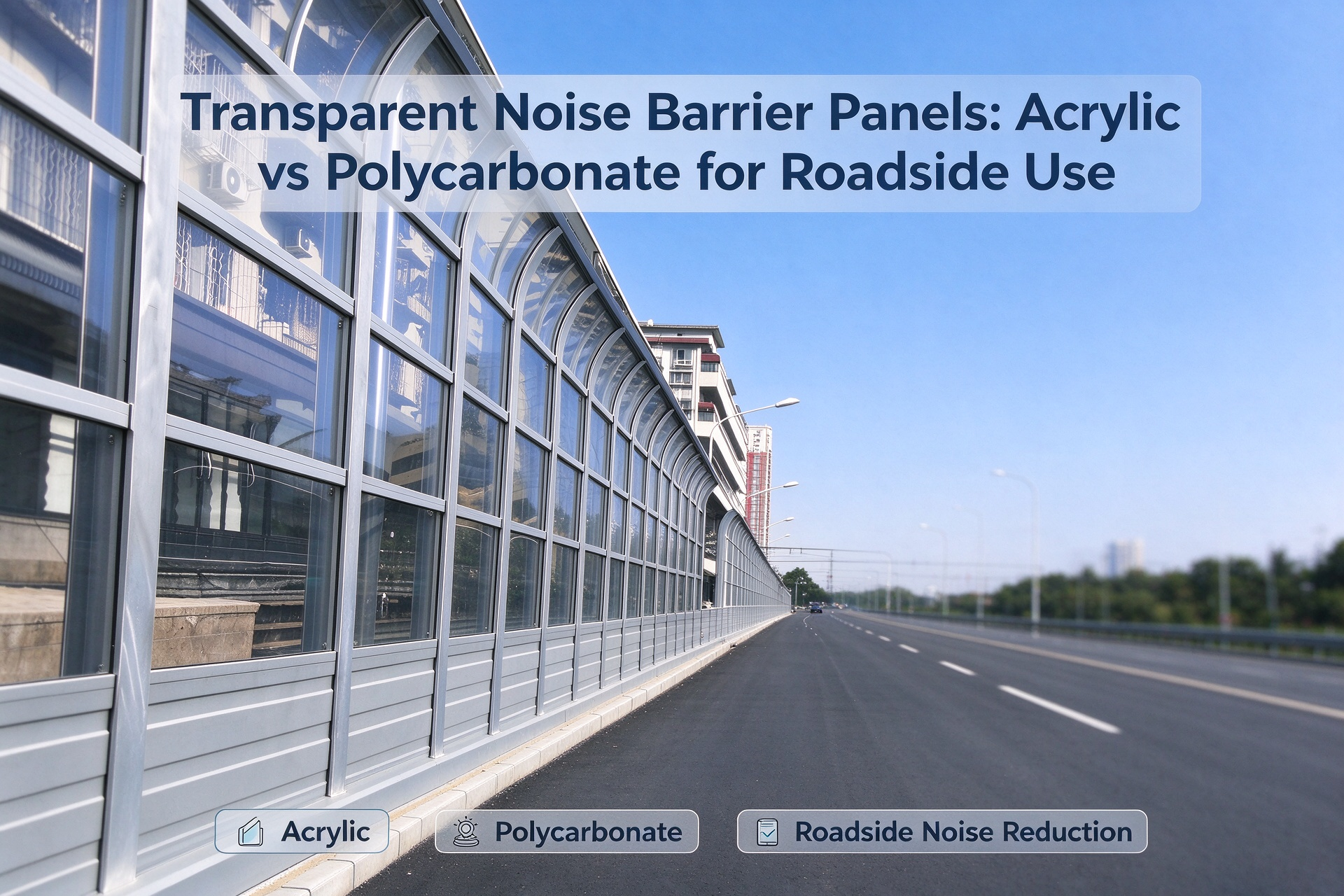
When a roadside barrier has to stay see-through, the specification usually narrows to two materials: acrylic (PMMA) and polycarbonate (PC). They look identical in a sample folder and behave very differently once traffic, sun and cleaning gangs get to them. This article sets out where each material wins, and how to mix them across the rows of one transparent noise barrier.
What a Transparent Noise Barrier Panel Has to Do on a Road
A clear screen on a highway or urban road is usually there for one of three reasons: to keep daylight and a view for the properties behind it, to preserve sight lines at a junction or an access, or to avoid the visual weight of a solid wall. Whatever the reason, the panel then has to deliver three things at once.
- Acoustic performance. The panel must be airtight and heavy enough to act as a barrier rather than a window; a gap or a slack gasket undoes the screen.
- Impact resistance. Roadside glazing takes stones from tyres, thrown objects, mower debris and occasional vehicle contact.
- Optical durability. It must stay clear enough to be worth having, year after year, without a cleaning regime that damages it.
Acrylic and polycarbonate are traded against each other on exactly these three points, and the balance shifts from one stretch of road to the next.
Acrylic (PMMA): Where It Wins
An acrylic noise barrier is the better optical choice for long outdoor service. It has a saturated polymer backbone without the UV-sensitive structures found in some other transparent plastics, so it resists yellowing and keeps its light transmission well under normal exposure. Standard sheet transmits around 92 % of visible light when new.
It is also the more dimensionally predictable of the two, which matters on a long run of panels: the sheet behaves the same way in year ten as in year one, so haze and colour readings taken at handover stay comparable with readings taken later.
Its weakness is brittleness. Acrylic is notch-sensitive, so a sharp impact, a tight fixing hole or a hard fixing in direct contact with the sheet can propagate into a crack.
Polycarbonate (PC): Where It Wins
Polycarbonate is the impact material. Its resistance to a sudden blow is far higher than acrylic's, which is why it is preferred where stones, vandalism or vehicle contact are realistic risks — the lower rows of a screen beside a fast carriageway, for example, or any panel within reach of the public.
The trade-off is on the surface. Polycarbonate relies on a protective layer for UV stability; once that layer is worn through by abrasion, harsh cleaning agents or long exposure, yellowing and loss of clarity accelerate. It is also softer, so it scratches more readily than acrylic.
The Difference That Decides Transparent Noise Barrier Projects
In practice the decision rarely turns on the material datasheet. It turns on which failure the client is more able to live with:
- A cracked panel from impact — a structural failure that has to be replaced, and the reason polycarbonate gets specified.
- A hazy panel after years of weathering and cleaning — a gradual loss of the amenity the screen was bought for, and the reason acrylic gets specified.
On a site where both risks exist, the answer is usually not to pick one material for the whole transparent noise barrier, but to allocate the risk across the rows.
Row-by-Row Material Selection in One Transparent Noise Barrier
Transparent noise barrier screens usually follow the same logic, because the risks are distributed vertically:
- Lower rows (up to roughly 1.5 m to 2 m). The impact zone. Polycarbonate earns its place here, where debris, mower damage and casual vandalism arrive.
- Middle and upper rows. Reachable but far less exposed. Acrylic gives better long-term clarity for the same visual effect.
- Top row or top section. Often left as the absorber or the metal capping, so the screen still reads as a barrier from a distance.
A mixed screen costs a little more to detail, because two materials mean two fixing and gasket specifications, but it puts each material where its strength is actually used.
What the Roadside Does to Each Transparent Noise Barrier Material
- Salt and spray. Winter de-icing spray leaves deposits that hold dirt and cut light; both materials need regular washing for different reasons.
- Ultraviolet dose. Exposure is higher on a south-facing or open-exposure carriageway; acrylic tolerates it better, polycarbonate depends on its protective layer.
- Abrasion. Grit and roadside dust are worked into the surface by wind and by cleaning; polycarbonate shows it sooner.
- Thermal movement. Both materials move more than the aluminium or steel frame holding them, so clearance and elastic gaskets are essential regardless of which is chosen.
- Cleaning chemicals. Solvents, alcohol-based cleaners and abrasives will attack either material — and on polycarbonate they can strip the protective layer.
Specification Points That Matter More Than the Material Name
- State the material and the grade or the presence of a co-extruded UV layer, not just "transparent panel".
- State the panel thickness and the design wind load, so deflection is set by the structure rather than by cost.
- Require oversized fixing holes, elastic gaskets and a locating detail that does not clamp the sheet hard.
- Require a neutral-cure, transparent-compatible sealant by name, with the manufacturer's compatibility statement.
- Ask for haze and yellowness index figures on the delivered batch, so the condition of the transparent noise barrier can be tracked later.
Transparent Noise Barrier Materials at a Glance
- Impact resistance. Polycarbonate clearly ahead; this is the deciding factor in exposed or public locations.
- Optical durability. Acrylic ahead; it keeps transmission and resists yellowing under UV.
- Scratch resistance. Acrylic ahead; polycarbonate marks more easily.
- UV behaviour. Acrylic inherently stable; polycarbonate dependent on its protective layer.
- Typical use. Acrylic in the upper rows and quieter locations; polycarbonate in the lower impact rows and where vandalism is expected.
Frequently Asked Questions
Which is better for a roadside transparent noise barrier, acrylic or polycarbonate?
Neither is better in the abstract. Acrylic holds its clarity and colour better over a long outdoor life; polycarbonate absorbs impact far better. For a transparent noise barrier beside a fast carriageway, the usual answer is a mixed screen: polycarbonate in the lower impact rows and acrylic above them.
Can acrylic and polycarbonate be mixed in the same screen?
Yes, and it is common practice. The two materials differ in thickness and in how they should be fixed, so each row needs its own fixing and gasket specification, but the screen line, the frame and the acoustic performance of the transparent noise barrier stay unchanged.
Does a transparent panel reduce the acoustic performance of the barrier?
Not by itself. A transparent panel performs as a barrier as long as the screen remains airtight and the panel is dense enough to block transmission. Loss of performance usually comes from gaps, slack gaskets or missing seals rather than from the choice of glazing material.
How thick should a transparent noise barrier panel be?
Thickness follows the design wind load, the span between posts and the deflection limit the client is willing to accept, rather than a single standard figure. It should be stated as an output of the structural design, and verified with the panel supplier against the site's wind speed.
Next Step
Send us the barrier height, the post spacing and the location of the impact zone, and we will propose a row-by-row material allocation with thicknesses and fixing details for each. The PMMA noise barrier range and the noise barrier system overview are useful starting points.