
 EN
Introduction
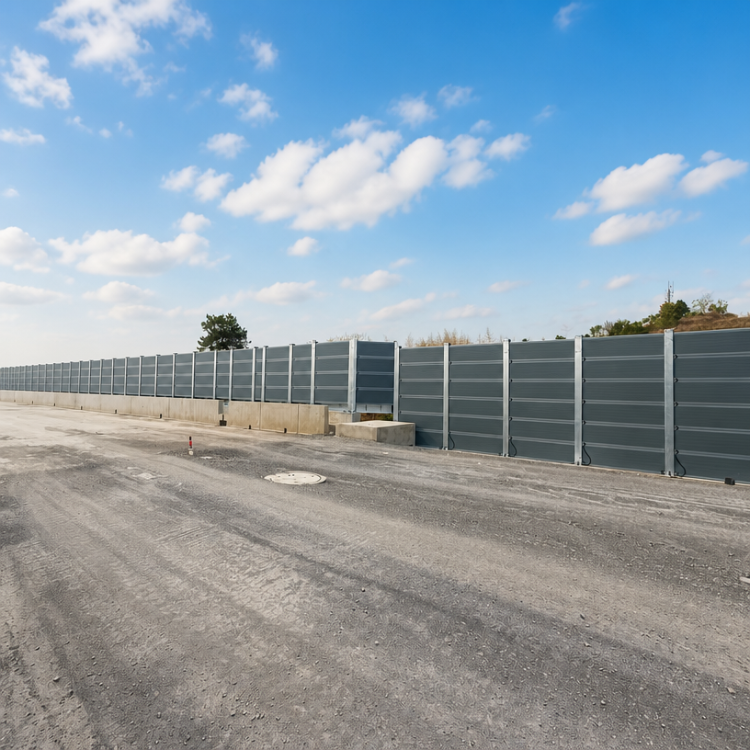
Road traffic supports trade, commuting, and regional development, but continuous vehicle movement can create unwanted sound for nearby homes, schools, hospitals, workplaces, and public spaces. Highway sound barriers, also called road noise barriers or acoustic barriers, are engineered to reduce the direct path between a traffic source and a receiver. This guide explains the working principle, common materials, design and installation considerations, applications, maintenance needs, and procurement questions for B2B projects.
How Highway Sound Barriers Work
A sound barrier does not eliminate traffic noise. Instead, it interrupts the line of sight between vehicles and the protected area, forcing sound to travel over or around the barrier. The barrier can reflect part of the sound, absorb part of it, or combine both effects, depending on its construction and surface treatment. Actual performance depends on the barrier’s position, height, length, continuity, gaps, terrain, traffic conditions, weather, and the surrounding buildings.
For this reason, a barrier should be considered as part of a wider noise-control design rather than as an isolated product. Openings for access, drainage, utilities, or emergency services need careful detailing because untreated gaps can reduce the overall effectiveness of the system.
Common Materials for Road Noise Barriers
Concrete
Concrete panels provide a substantial, durable solution for many highway and infrastructure projects. Their mass can help limit sound transmission, while their robust construction can suit exposed locations. Designers should check structural loading, foundations, transport, lifting, finish, and drainage requirements.
Metal and Perforated Acoustic Panels
Metal systems are often selected for their modular construction, adaptable appearance, and efficient installation. Perforated metal panels may be paired with an acoustic core or absorber. The coating, corrosion protection, panel joints, and edge details should match the local environment and the expected service conditions.
Transparent Panels
Transparent acoustic panels can preserve sightlines, daylight, and the visual openness of a road corridor. They require attention to impact resistance, frame design, cleaning access, weathering, and replacement procedures. The specification should identify the transparent material and its tested performance rather than relying on appearance alone.
Timber, Composite, and Other Systems
Timber and composite systems can support architectural or environmental objectives when their durability, fire behavior, moisture resistance, and maintenance requirements are suitable for the site. Hybrid designs may combine different materials to balance acoustic performance, appearance, weight, and cost.
Design and Installation Considerations
Define the noise-control objective. Start with the protected receivers, traffic source, operating conditions, local regulations, and project constraints. Acoustic modeling or an appropriately qualified assessment can help determine the required arrangement; a generic height or panel type should not be assumed to work in every location.
Plan continuity and geometry. The barrier normally needs sufficient length and continuity to protect the target area. Returns, overlaps, transitions, bridge interfaces, expansion joints, and end treatments deserve the same attention as the main panels. Gaps around posts, gates, utilities, and drainage should be minimized or treated according to the design.
Coordinate structural and civil works. Wind actions, self-weight, impact risk, foundation conditions, soil, drainage, road clearance, utilities, and access for lifting equipment all influence the support system. Panel dimensions and post spacing should be coordinated with transport and installation logistics.
Consider visibility and safety. Transparent sections, color, surface finish, lighting, bird-safety measures where relevant, maintenance access, and driver sightlines may affect the final specification. The barrier should not create hazards or obstruct required road signs and safety equipment.
Use documented performance. Ask suppliers for relevant test information, material specifications, drawings, coating details, installation instructions, and limitations. Acoustic claims should be connected to a defined test method or project assessment, not only to a marketing label.
Typical Applications
Highway sound barriers are used beside motorways, expressways, ring roads, bridges, ramps, and urban arterials. They may also be considered near rail or mixed-transport corridors, logistics routes, industrial access roads, and large developments where road traffic affects nearby occupied areas. The right solution varies with land use, road geometry, available space, architectural expectations, climate, and local requirements.
Maintenance and Service Planning
A maintenance plan should cover routine visual inspections, fasteners and joints, posts and foundations, panel damage, corrosion, sealants, drainage, vegetation, graffiti, cleaning, and access systems. Transparent panels may need regular cleaning to preserve visibility. Damaged components should be assessed promptly, and replacement parts should be identifiable and available for the expected service period.
Where the barrier is exposed to salt, moisture, dust, freeze-thaw conditions, or vehicle splash, the specification should address suitable materials and protective finishes. Keeping installation records, product references, and inspection notes can simplify future repairs and procurement.
Procurement Advice for B2B Buyers
Before requesting quotations, prepare a project brief with location, approximate alignment, drawings or site information, target receivers, traffic context, required clearances, preferred appearance, access limitations, delivery conditions, and applicable standards. Ask each supplier to separate panel, post, foundation, accessory, transport, installation, testing, and maintenance assumptions so proposals can be compared fairly.
Useful questions include: What materials and protective systems are proposed? How are joints and gaps treated? What site conditions are assumed? Which drawings and calculations are included? How will damaged panels be replaced? What quality documents, warranty terms, lead times, and installation support are available? A capable supplier should explain both the benefits and the limitations of the proposed system.
Conclusion
Highway sound barriers reduce the direct transmission of road traffic noise by placing a designed acoustic obstruction between the source and the protected receiver. Material selection, continuity, geometry, structural support, installation quality, documented performance, and long-term maintenance all influence the result. For an effective B2B project, buyers and suppliers should define the site objective clearly, coordinate acoustic and civil requirements early, and compare complete, evidence-based proposals rather than choosing on panel price alone.