
 EN
EN

Solution for Noise Reduction of Power Plant Sound Barriers
1. Sources of Power Plant Noise and the Noise Reduction Principles of Sound Barriers
Power plants generate a wide variety of noise sources with complex frequency characteristics. Based on their origins, these noises can be categorized into mechanical noise (caused by equipment vibration, friction, and impact, mainly in the low- and mid-frequency range), aerodynamic noise (from air intake/exhaust systems and cooling tower water splashing, characterized by a wide frequency spectrum), and electromagnetic noise (generated by transformers and other electrical equipment).
In coal-fired power plants, boiler auxiliary equipment, induced draft fans, and turbine generators are the primary noise contributors. In gas-fired power plants, gas turbines, heat recovery steam generators (HRSGs), and cooling towers are the dominant noise sources. For gas engine power stations, outdoor-installed generating units themselves are often significant sources of high noise levels.
The noise reduction mechanism of a sound barrier lies in physically blocking and altering the propagation path of sound waves. When sound waves encounter a barrier, part of the energy is reflected back toward the source, part is absorbed by the barrier material and converted into heat, and the remaining portion diffracts around the barrier edges. The barrier creates an acoustic shadow zone between the noise source and the protected area, allowing the receiver location to benefit from insertion loss. The overall noise reduction performance depends on factors such as barrier height, distance from the sound source, sound absorption and insulation properties of the barrier, and the design of the barrier top. Effective engineering design must balance acoustic performance with economic efficiency.
2. Core Materials and Structural Systems of Sound Barriers
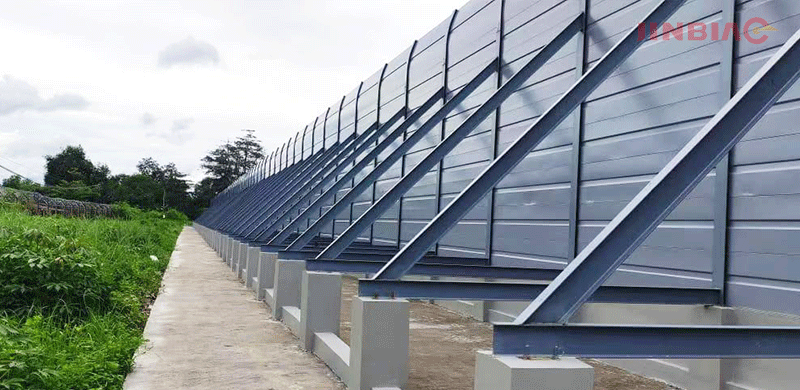
The acoustic performance of a sound barrier is fundamentally determined by its material composition. The most widely used solution today is a composite structure that combines sound absorption and sound insulation. This structure typically consists of perforated facing panels (metal or non-metal), sound-absorbing materials (such as glass wool, superfine glass fiber, or rock wool), and sound-insulating backing panels (steel sheets or composite boards).
The sound-absorbing layer is usually 50–100 mm thick, with a density ranging from 20 to 80 kg/m³, enabling effective absorption of incident sound waves. The backing panel prevents sound transmission through the barrier. In addition to acoustic performance, selected materials must meet Class A fire resistance requirements and possess excellent weather resistance and moisture resistance.
From a structural perspective, vertical sound barriers are suitable for plant boundary protection and equipment isolation. L-shaped barriers or barriers equipped with overhanging tops enhance diffraction attenuation and provide greater noise reduction. Fully enclosed barriers are commonly used for coal conveyor galleries and high-noise equipment zones where substantial attenuation is required. Removable steel-framed barriers facilitate equipment maintenance and are ideal for areas requiring frequent inspection and servicing. Modular designs are increasingly preferred due to their ease of installation and flexibility for future modifications.
3. Typical Application Solutions
Sound barrier solutions for power plants must be tailored to the characteristics of different noise sources.
Cooling tower noise control is one of the most challenging applications because cooling towers typically have large sound-radiating surfaces and are installed outdoors. Semi-enclosed or fully enclosed sound barriers are often constructed around the tower perimeter. In some projects, barriers are combined with silencers and noise reduction screens to effectively reduce both water-splash noise and aerodynamic noise.
In main plant buildings and auxiliary equipment areas, indoor noise sources are primarily controlled through building enclosure sound insulation and ventilation silencing measures. Outdoor auxiliary equipment, such as fans and transformers, is commonly treated with localized acoustic enclosures or regional sound barriers. For long-distance conveying systems such as coal conveyor corridors, fully enclosed sound-insulating and sound-absorbing barriers can achieve noise reductions exceeding 20 dB.
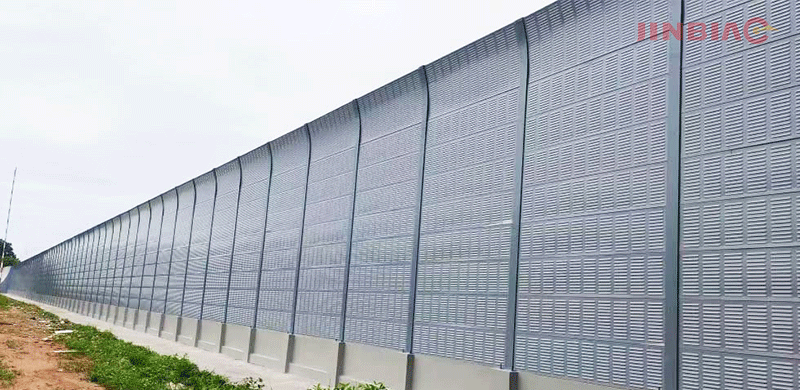
Compliance with plant boundary noise limits is a critical operational requirement. Sound barriers are often integrated with perimeter walls to serve as the final line of defense against environmental noise. For existing power plants facing stricter environmental noise regulations, upgrades can be implemented by increasing barrier height or adding sound-absorbing layers to the inner surface, eliminating the need for complete reconstruction.
Special applications such as gas engine power stations require a balance between noise control and equipment ventilation. High-porosity sound-absorbing materials and large ventilation openings are used to ensure both effective noise reduction and safe equipment operation.
Conclusion
Power plant sound barrier solutions have evolved into a comprehensive technical system covering materials, structural design, engineering, installation, and performance verification. From traditional composite sound barriers to innovative photovoltaic sound barriers that combine noise reduction with renewable energy generation, technological advancements continue to expand the value of noise control projects.
Looking ahead, the adoption of acoustic metamaterials, artificial intelligence-based optimization algorithms, and sustainable low-carbon materials will drive sound barriers toward higher efficiency, greater intelligence, and improved sustainability. For the global power generation industry, sound barriers are not only essential tools for meeting environmental compliance requirements but also important investments in corporate social responsibility and community relations.
Against the backdrop of energy transition and low-carbon development, innovative products that integrate noise reduction and clean energy generation are expected to become a new benchmark for power plant environmental noise control, creating both environmental and economic value.