
 EN
EN

How Long Does an Acrylic Noise Barrier Last?
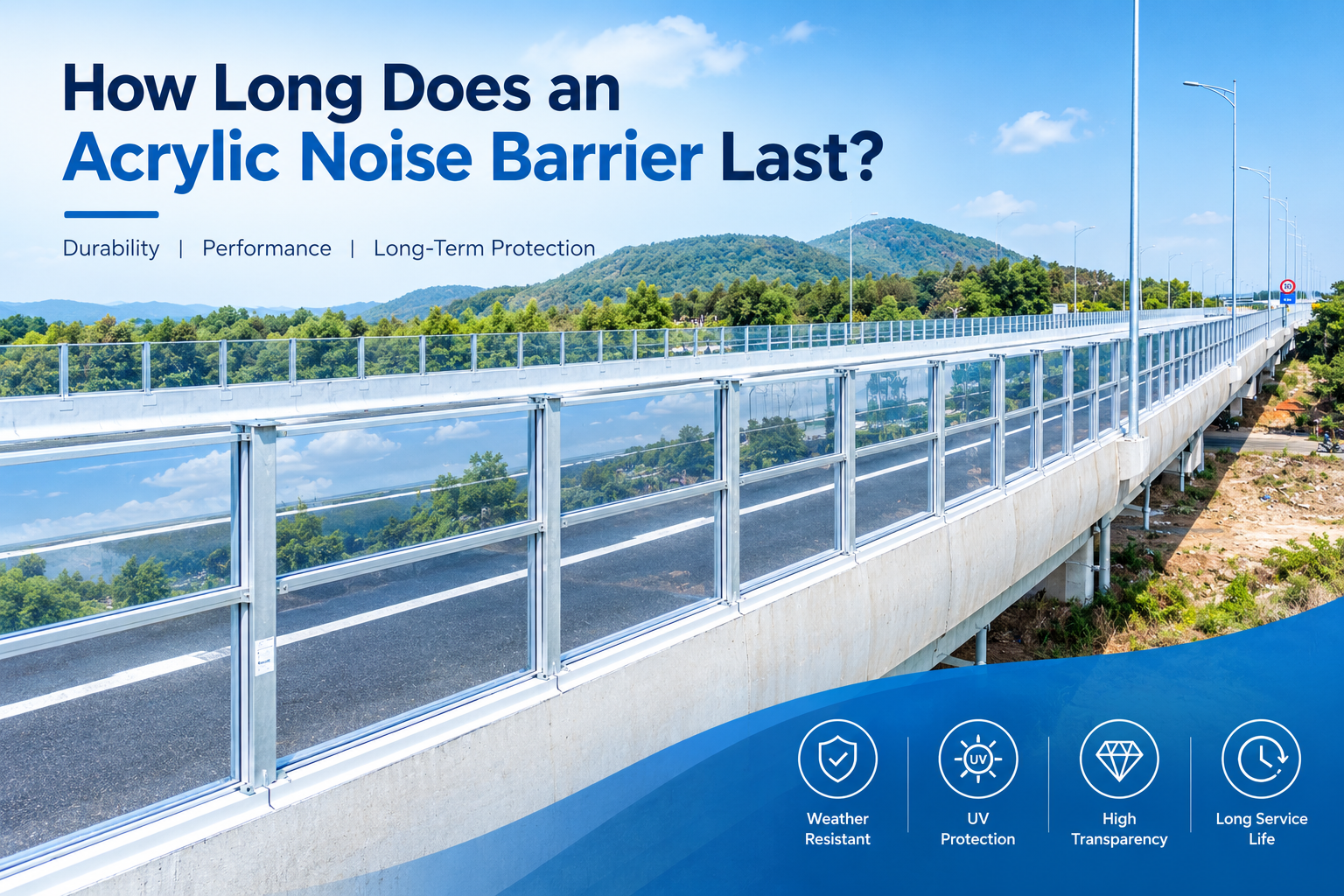
Clients specifying a transparent acrylic barrier usually ask one of two questions: how long will it stay clear, and how long before something has to be replaced. The answer is that an acrylic noise barrier is not one product with one lifespan. It is a panel, a frame, a set of gaskets and a set of fixings, and each of those ages at a different rate. This article explains what decides the service life of each, and how to get the longest life out of the installation.
The Short Answer
Acrylic sheet is one of the more weather-stable transparent plastics, and barrier projects commonly assume a design life for the panel in the region of ten to twenty years, with the frame, gaskets and fixings often needing attention before the sheet itself does. That range is an industry convention, not a fixed figure — it depends on the grade of sheet, the UV protection built into it, the exposure of the site, the fixing detail and how the installation is cleaned and inspected.
Two things matter more than the number itself when planning an acrylic noise barrier:
- An acrylic noise barrier rarely fails all at once. It degrades gradually through haze, colour shift and surface change.
- The usual cause of early replacement is not the material but the detailing around it — stressed fixing holes, incompatible sealants, or cleaning with the wrong product.
Why an Acrylic Noise Barrier Weathers Differently
The durability of an acrylic noise barrier starts with the polymer. PMMA has a saturated carbon backbone without the UV-sensitive structures found in some other transparent plastics, which is why it keeps its light transmission and resists yellowing well under normal outdoor exposure. Standard sheet transmits around 92 % of visible light when new, and that figure falls only slowly in a properly specified panel.
What varies between products is the protection added on top of the base polymer. Co-extruded UV-absorbing layers, the difference between cast and extruded sheet, and the quality control of the extrusion all change how the panel behaves after several years of sun, rain and pollution. A cheap sheet and a properly specified sheet can look identical on the day of installation and quite different five years later.
What Determines the Life of an Acrylic Noise Barrier
- Grade and UV protection. Cast sheet generally offers better chemical and stress-cracking resistance than extruded sheet; a co-extruded UV layer protects the base polymer from the surface inwards.
- Panel thickness and span. A thin panel across a wide span deflects more under wind, which works the fixings and the gaskets harder.
- Site exposure. Coastal salt spray, industrial pollutants, high ultraviolet dose and repeated thermal cycling all accelerate ageing.
- Fixing detail. Oversized holes, hard fixings in direct contact with the sheet, and insufficient clearance for thermal movement are the classic causes of cracking.
- Sealant and gasket selection. Neutral-cure products and elastic gaskets suit acrylic; aggressive or incompatible chemistry attacks it.
- Maintenance regime. Regular cleaning with mild soap and water extends life; solvent-based cleaners and abrasive pads shorten it sharply.
The Failure Modes to Watch
- Yellowing. Measured as a yellowness index; a gradual colour shift towards amber.
- Haze and loss of transmission. Surface erosion and micro-scratching reduce clarity before the panel is structurally affected.
- Crazing. Fine surface cracks that appear where stress, chemical attack and weathering meet — usually around holes, edges and fixings.
- Cracking and edge damage. Acrylic is notch-sensitive, so an impact or an over-tightened fixing can propagate into a crack.
- Gasket hardening. Seals lose elasticity, which lets water in and can cost acoustic performance.
- Fixing corrosion. More often seen on coastal sites, and a common reason for intervention on an otherwise sound acrylic noise barrier.
Acrylic vs Polycarbonate in a Noise Barrier
The two transparent materials fail in different ways, and the choice for a transparent noise barrier should follow the risk on site. Acrylic holds its clarity and colour better over time and resists UV ageing well, but it is more brittle and can crack from a sharp impact. Polycarbonate is far more impact resistant, which suits locations exposed to thrown stones or vandalism, but its optical surface depends on a protective layer; once that layer is worn through by abrasion or harsh cleaning, yellowing accelerates.
Where both visibility and impact resistance are required, a mixed screen — acrylic in the upper rows, polycarbonate in the lower, impact-exposed rows — is a common compromise.
How the Frame Around an Acrylic Noise Barrier Ages
The metal frame usually outlasts the panel, but the interface between them is where problems usually start. Aluminium and galvanized steel posts expand less than acrylic under the same temperature change, and an acrylic panel moves roughly three times as much as the aluminium holding it. If that movement is restrained, stress builds up in the sheet every day of the year.
Practical consequences for any acrylic noise barrier:
- Fixing holes should be oversized and the panel should be located by the gasket, not clamped hard by the bolt.
- Elastic gaskets should be used to isolate the sheet from the metal and to absorb movement.
- Only neutral-cure sealants compatible with acrylic should be used, and the sealant supplier's compatibility advice should be followed in writing.
How Life Is Assessed
Two methods are used in combination. Laboratory accelerated weathering exposes samples to xenon-arc or fluorescent UV with periodic condensation, then measures haze and yellowness index before and after, so grades can be compared on a like-for-like basis. On site, the same measurements plus a visual check for crazing around fixings give a practical condition report for an existing acrylic noise barrier.
For an asset owner, an annual visual inspection with photographs of the same panel positions is usually enough to catch the early signs that matter — a hardening gasket, a crazed hole, a run of panels starting to haze.
How to Specify for a Longer Life
- State the required sheet grade and whether a co-extruded UV layer is required, rather than only stating "acrylic".
- State the design wind load and the panel deflection limit, so the thickness is set by the structure rather than by cost.
- Require the fixing and gasket detail to allow thermal movement, and ask for it to be shown on the shop drawing.
- Require neutral-cure, acrylic-compatible sealant by name, with the manufacturer's compatibility statement.
- Ask for haze and yellowness index data on the delivered batch, not only on a generic datasheet.
Maintenance That Adds Years
- Clean with plenty of water and a mild neutral soap, using a soft cloth or sponge.
- Do not use solvents, alcohol-based cleaners, ammonia or abrasive pads on acrylic.
- Rinse salt and dust off coastal screens more often than inland ones.
- Re-torque or check fixings periodically, and replace hardened gaskets rather than refilling around them.
- Record panel positions in photographs so change over time can be judged rather than guessed.
A written cleaning routine is the least expensive way to extend the life of an acrylic noise barrier.
Frequently Asked Questions
How long does an acrylic noise barrier last?
Barrier projects commonly assume a design life for the acrylic panel in the region of ten to twenty years, depending on the sheet grade, its UV protection, the site exposure and the fixing detail. The frame, gaskets and fixings are usually addressed first, so the practical service life of the screen is set by whichever component is maintained and replaced on schedule.
Will acrylic turn yellow?
All transparent plastics shift in colour to some degree over time. Acrylic resists UV yellowing better than many alternatives because of its polymer structure, and a co-extruded UV layer on a properly specified sheet slows it further. The change is normally gradual and measurable rather than sudden.
Can an acrylic noise barrier be repaired?
Local damage can sometimes be dealt with by replacing the individual panel or the gasket run, which is one advantage of a modular acrylic noise barrier. Crazing that has spread across a panel, or a crack crossing the fixing line, normally means the panel should be replaced rather than repaired. Replacement panels should be matched for grade and thickness so performance and appearance stay consistent.
Which lasts longer, acrylic or polycarbonate?
For clarity and colour retention, acrylic generally performs better over a long outdoor life; for impact resistance, polycarbonate is the stronger choice. In practice the answer depends on the site: where thrown stones or vandalism are a real risk, polycarbonate or a mixed screen usually gives the longer trouble-free service despite its more vulnerable optical surface.
Next Step
Send us the screen dimensions, the design wind load and the site conditions. We will confirm the sheet grade, thickness and fixing detail for your acrylic noise barrier, and supply haze and yellowness data with the delivery so the condition of the screen can be tracked from day one. Two useful starting points are the PMMA noise barrier range and the PVC and acrylic noise cancelling wall.