
 EN
EN

Airport Fence Buying Guide: Specs and Supplier Checks
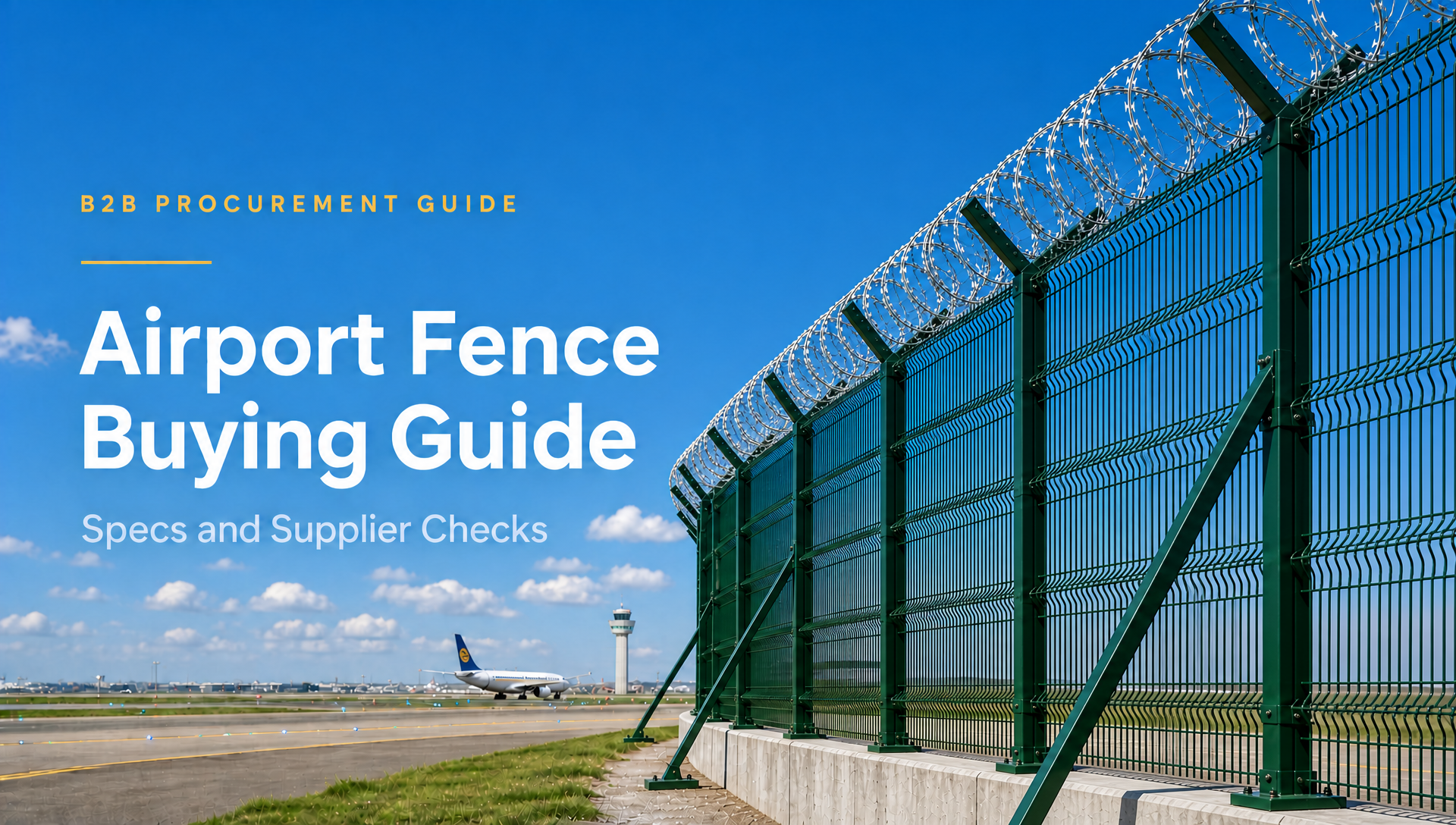
Buying an airport fence is a procurement decision with long consequences. The perimeter is the first layer of aviation security, and a fence line built to a weak specification will keep demanding money and attention for twenty years. This guide follows the order a real project runs in: plan, specification, enquiry, quotation.
Start With the Security Plan
Airports are not uniform. Runways, aprons, fuel farms, cargo areas and maintenance yards each carry a different risk, and civil aviation rules treat them differently too. Before an airport fence is specified, the project needs a perimeter security plan that divides the boundary into zones and states what is expected in each.
That plan is also the document a supplier will ask for. Without it, every quotation rests on different assumptions, and the cheapest quotation is often the one that assumed the least.
Set Airport Fence Height Zone by Zone
Height follows risk. Airport fence systems typically fall into a narrow range:
- 2.4 m — low-risk service, utility and landscape boundaries
- 2.7 m to 3.0 m — the main operational perimeter
- 3.0 m to 3.6 m or more — critical zones such as fuel storage, cargo aprons and control areas
In open ground, height should be read together with the topping. A 2.4 m airport fence panel carrying concertina wire on cranked arms is a different obstacle from a 3.0 m flat panel. Ask for the topping to be priced separately so both options can be compared fairly.
Choose the Airport Fence Panel Type per Zone
Several panel types appear on airport fence projects, and the right answer is usually a combination rather than one system across the whole boundary.
358 high-security mesh uses a small aperture, commonly 76.2 mm × 12.7 mm. The fingers and tools that make climbing or cutting possible do not fit, which is why it is the usual choice for terminals and fuel farms.
V mesh panels are welded mesh pressed into horizontal V-shaped profiles. The bends act as stiffening ribs, so the panel holds its shape over long spans without a heavy frame. This is the common choice for long perimeter runs; the reasoning is set out in our article on why airport fence uses V mesh.
Double wire panels weld twin horizontal wires to a single vertical wire, producing a rigid panel that resists impact well, and suit car parks and maintenance compounds inside the perimeter.
Chain link stays economical for secondary boundaries, but its woven diamond mesh is climbable and needs a barbed or razor topping before it can serve as a security line. Our airport perimeter protection solution shows how these panels are combined with detection and access control.
Specify Airport Fence Posts, Foundations and Wind Load
Airport land is flat and exposed, so wind rather than weight governs the structure. Three items follow from that:
- Post section and spacing. Longer spans suit V mesh because the profile carries its own stiffness, but spacing still has to be calculated against the design wind speed.
- Foundation type. Concrete footings are normal in open ground; rock, made ground or buried services may need an alternative detail, which should be priced rather than assumed.
- Structural height. The quotation should state mesh height and topping height separately.
Ask for the airport fence wind load figure in writing. A supplier who quotes a post spacing without a stated wind speed has not designed anything yet.
Decide on Coatings for the Local Climate
Coating selection is where coastal and inland airports diverge. Hot-dip galvanizing protects the steel core, and a polyester powder coating adds colour and a further barrier against salt and humidity. For coastal sites, specify the galvanizing weight per square metre and the coating thickness, and ask how cut ends and welds are protected.
Colour matters for more than appearance. A dark green or grey finish reduces glare for controllers and pilots, and a consistent colour along a long airport fence line makes damage easier to spot on patrol.
What to Put in Your Airport Fence Enquiry
A complete enquiry shortens the quotation cycle and removes the assumptions that cause disputes later. Send:
- Perimeter drawing or site plan, with the zones marked
- Required height, panel type and aperture for each zone
- Design wind speed, and ground conditions where known
- Coating requirement: galvanizing weight and top coat
- Gate positions, widths and the access control they must accept
- Topping: none, barbed wire or concertina razor wire
- Delivery port and on-site date
Suppliers can work from less, but the quotation will carry more assumptions — and every assumption is a potential variation order.
How to Compare Airport Fence Quotations
Quotations for airport fence systems are rarely like for like. Normalise them before comparing:
- Price per metre, and what it includes. Panel, post, footing, topping, fixings and installation should be listed separately.
- Wire diameter and mesh aperture. A thinner wire or a wider aperture cuts cost without being obvious in a photograph.
- Galvanizing weight in g/m², which sets the service life of the steel.
- Steel grade and wall thickness of posts and rails.
- Exclusions. Foundations, civil works, gates, detection and unloading are commonly excluded.
Two quotations that differ by fifteen per cent are usually not offering the same fence. Find the difference in the specification before negotiating price.
Check the Airport Fence Supplier Before You Order
Over a long perimeter the factory matters as much as the drawing. Ask for galvanizing and coating test reports for the production batch, welding and aperture inspection records, a reference from a comparable airport perimeter project, the container loading plan, and warranty terms written into the contract rather than only the brochure.
A supplier who answers specification questions with specification answers is a safer partner than one who answers with adjectives.
What Drives Airport Fence Cost
Budget discussions go better when the cost drivers are named. For an airport fence they are height and zone mix, panel type, coating system, ground conditions and site access. Each extra panel row raises material and installation cost along the whole length; small-aperture mesh and heavier coating cost more per square metre; rock, made ground or soft soil change the foundation cost; and a perimeter crossing live operations is slower to install than open farmland.
Because the perimeter is measured in kilometres, small specification decisions have large budget effects. Settle the zonal plan before the tender, not during it.
Delivery, Installation and Acceptance
Panels are bulky, so shipping cost follows packing efficiency rather than weight alone. Confirm whether posts, panels and topping ship in the same container — a missing topping can hold up the whole fence line.
At handover, walk the airport fence line and check plumb, post spacing against the drawing, foundation finish, gate operation, topping tension and coating damage from handling. Record defects with positions and photographs, and confirm in writing that the delivered mesh and coating match the specification you ordered.
Airport Fence Buying Mistakes to Avoid
- Treating the whole perimeter as one zone, overspending in low-risk areas or underspecifying critical ones.
- Buying on price per metre without normalising wire diameter, aperture and galvanizing weight.
- Leaving gates and access control out of the airport fence package, so the security level drops at every entry point.
- Expecting the fence to replace detection, CCTV and patrol routines rather than work with them.
Frequently Asked Questions
What height should an airport fence be?
Projects commonly use 2.4 m for low-risk boundaries, 2.7 m to 3.0 m for the main operational perimeter, and 3.0 m to 3.6 m or more for critical zones such as fuel storage and control areas. The zone risk assessment decides it, and the topping counts towards effective height.
Should an airport fence use 358 mesh or V mesh?
358 mesh is specified for its anti-climb and anti-cut performance, so it suits critical zones. Where rigidity, wind performance and cost must be balanced over long perimeter runs, V mesh is often the more practical selection. Many projects use both.
How do I compare airport fence suppliers?
Ask every supplier for the same items in writing: wire diameter and aperture, galvanizing weight in g/m², steel grade and post wall thickness, coating system, wind load basis and warranty terms. Once those sit on one sheet, quotations can be compared on specification instead of headline price.
How long does an airport fence project take?
The programme depends mainly on perimeter length, ground conditions and whether installation crosses live operations. Production is normally shorter than installation, so the critical path is usually access and foundations. Ask for a dated programme with the quotation.
Next Step
Send us your perimeter plan, the zone heights and your coating requirement. We will return an airport fence specification with a panel and post schedule, a separate price for the topping and gates, and the documents you need to evaluate the offer. If you are still comparing panel types, start with the perimeter security fence range.