
 EN
EN

Temporary vs Permanent Metal Noise Barriers: A Comprehensive Comparison
1. Material and Structural Comparison
Temporary Metal Noise Barriers
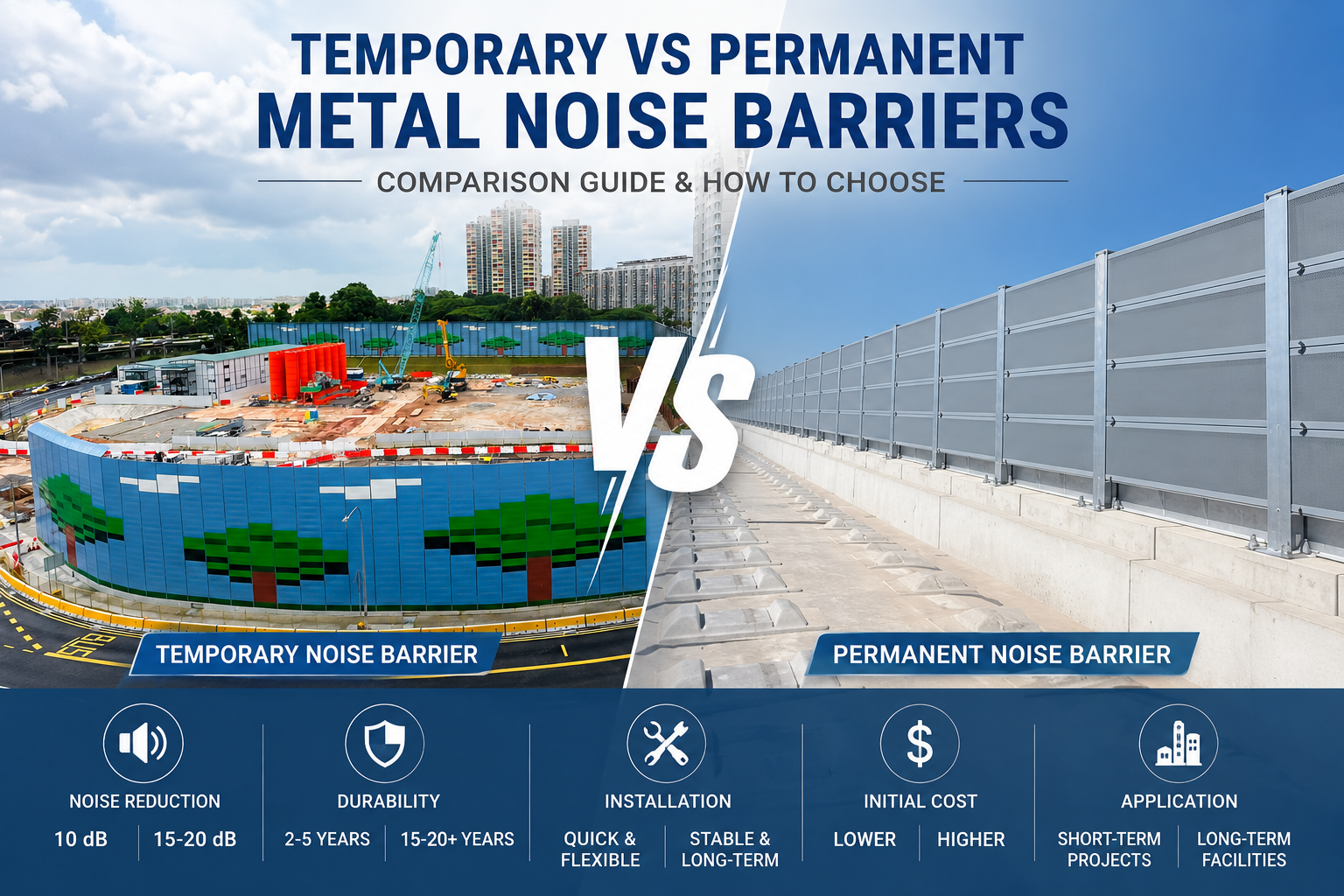
Temporary metal noise barriers are typically designed to be lightweight for easy transportation and rapid deployment. Common materials include galvanized steel sheets and aluminum alloy panels, with metal sheet thickness generally ranging from 0.5 mm to 1.5 mm.
The barrier panel usually features a three-layer composite structure:
• Outer layer: perforated metal sound-absorbing panel
• Core layer: sound-absorbing material (such as rock wool or glass wool)
• Inner layer: sound-insulating backing panel
The overall panel thickness is typically around 50 mm.
Permanent Metal Noise Barriers
Permanent metal noise barriers are built with heavier and more robust materials. They also utilize galvanized steel or aluminum alloy panels, but with greater panel thickness and higher structural strength.
Permanent barriers commonly adopt a scientifically designed structure consisting of a micro-perforated sound-absorbing panel and a sound-insulating backing panel. The micro-perforated surface efficiently absorbs sound waves, while the backing panel provides both sound insulation and structural support.
The support system of permanent barriers is significantly stronger, typically using hot-dip galvanized H-beam steel posts (such as 100×100×6×8 mm or 125×125×6.5×9 mm specifications). These posts are bolted or welded to embedded steel plates, ensuring long-term structural stability.
In addition, permanent barriers are usually protected by a dual anti-corrosion treatment consisting of hot-dip galvanizing and powder coating, allowing them to withstand various outdoor environmental conditions.
2. Noise Reduction Performance Comparison
| Performance Indicator | Temporary Metal Noise Barrier | Permanent Metal Noise Barrier |
| Sound Transmission Loss | 10 dB | 15–20 dB |
| Noise Reduction Effect | Good, suitable for short-term noise control | Excellent, suitable for strict environmental standards |
Performance Indicator Temporary Metal Noise Barrier Permanent Metal Noise Barrier
Sound Transmission Loss 10 dB 15–20 dB
Noise Reduction Effect Good, suitable for short-term noise control Excellent, suitable for strict environmental standards
Temporary metal noise barriers provide sufficient noise reduction for most short-term industrial applications, such as equipment maintenance and construction projects.
Permanent metal noise barriers offer superior acoustic performance, with average sound insulation levels reaching 15–20 dB. For long-term projects that must comply with stringent environmental regulations, permanent metal barriers are a more reliable solution.
3. Installation and Deployment Comparison
Temporary Metal Noise Barriers: Fast and Flexible
The primary advantage of temporary noise barriers is rapid deployment. Their modular design allows for quick and simple installation, making them ideal for projects requiring immediate noise control.
Permanent Metal Noise Barriers: Stable but Time-Consuming
Installing a permanent noise barrier is a comprehensive engineering process. It generally involves:
1.Foundation construction (concrete foundations or continuous concrete footings)
2.Installation of H-beam steel posts
3.Insertion of barrier panels into the post slots
The installation process includes civil works, steel structure assembly, and acoustic system installation, often requiring several days to several weeks.
However, once completed, the barrier becomes a permanent part of the facility and does not require repeated assembly or relocation.
4. Service Life and Durability Comparison
| Comparison Item | Temporary Metal Noise Barrier | Permanent Metal Noise Barrier |
| Design Service Life | 2–5 years (reusable) | 15–20+ years |
| Corrosion Protection | Galvanized or powder-coated | Hot-dip galvanized + powder-coated |
| Wind Resistance | Moderate | Excellent |
| Maintenance Requirement | Low | Low |
Design Service Life 2–5 years (reusable) 15–20+ years
Corrosion Protection Galvanized or powder-coated Hot-dip galvanized + powder-coated
Wind Resistance Moderate Excellent
Maintenance Requirement Low Low
Temporary metal noise barriers are generally designed for a service life of 2–5 years. Due to their reusable nature, proper storage and maintenance can significantly extend their practical lifespan across multiple projects.
Permanent metal noise barriers provide exceptional durability. With dual anti-corrosion protection through hot-dip galvanizing and powder coating, their service life can exceed 15–20 years. Steel support posts are typically designed for a lifespan of at least 30 years.
Permanent barriers can withstand strong winds, heavy rain, and other harsh weather conditions while maintaining superior structural integrity and safety.
5. Cost Comparison
Temporary Metal Noise Barriers
• Lower initial investment
• Minimal installation costs
• Suitable for short-term projects and temporary noise control requirements
Permanent Metal Noise Barriers
• Higher upfront investment
• Costs include planning, materials, foundation construction, post installation, and professional installation services
• More economical over the long term due to extended service life
6. Application Scenarios Comparison
Suitable Applications for Temporary Metal Noise Barriers
• Construction sites where barriers need to move as work progresses
• Short-term industrial activities such as equipment commissioning or temporary production operations
• Temporary outdoor events including music festivals, sporting events, and exhibitions
Suitable Applications for Permanent Metal Noise Barriers
• Industrial facility boundaries requiring long-term noise control
• Fixed equipment areas such as compressor stations, pumping stations, and power plants
• Transportation infrastructure including highways, railways, and urban expressways
• Manufacturing facilities that must continuously comply with environmental noise regulations
7. Summary and Selection Guide
Temporary and permanent metal noise barriers are not competitors but solutions designed for different project requirements.
Choose a Temporary Metal Noise Barrier If:
✅ The project duration is less than 2–3 years or involves phased construction.
✅ The noise source location changes frequently and the barrier must be relocated.
✅ Noise control needs to be deployed within a very short timeframe (often within a few hours).
Choose a Permanent Metal Noise Barrier If:
✅ The facility will operate long-term and noise issues are expected to persist for more than 15 years.
✅ Higher noise reduction performance is required to meet strict environmental standards (typically 35–45 dB sound insulation performance).
✅ The site layout is fixed and barrier relocation is unnecessary.
✅ You prefer a one-time investment that minimizes long-term lifecycle costs.
✅ High structural stability, durability, and wind resistance are critical project requirements.