
 EN

Solar Farm Fence Styles: An Introduction to Perimeter Options
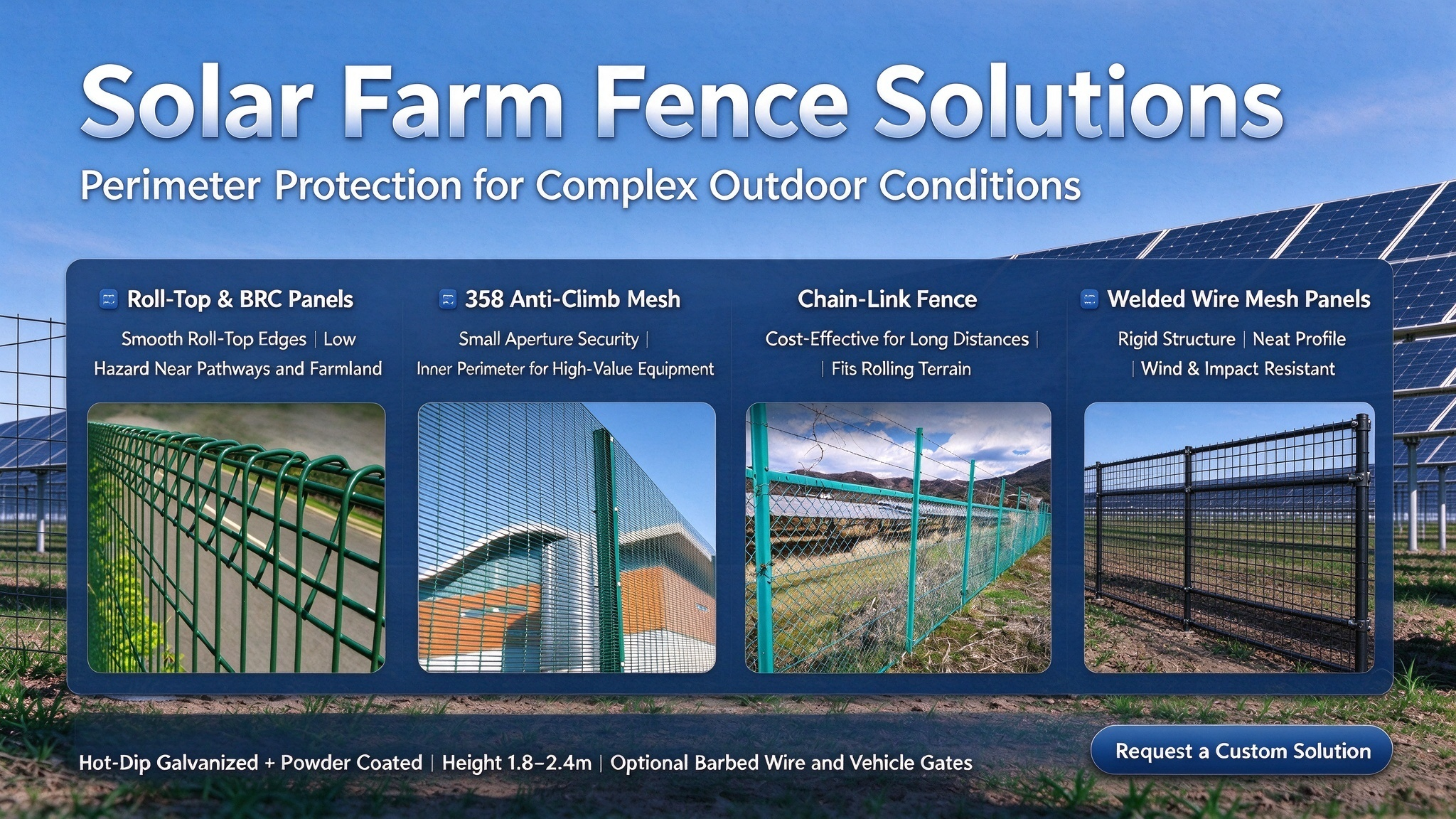
A solar farm is an outdoor asset with a long service life and a wide, open perimeter. Modules, cabling, combiner boxes, inverters and transformers sit in fields that are often remote from the operator's base, and the solar farm fence has to do several jobs at once: keep people out, control livestock, allow maintenance access, and survive wind, dust, salt and ultraviolet exposure.
This introduction sets out the solar farm fence styles used on photovoltaic projects, what separates them, and how to choose between them.
Why the perimeter fence matters
Perimeter security is not only about theft. A solar farm fence defines the operating boundary, supports access control, and separates the public from energised equipment. The risks a solar farm fence is expected to address include:
• Removal of modules, cable and copper earthing conductors
• Unauthorised entry by the public, including children
• Grazing animals rubbing against panels and cabling
• Vehicle incursion at access points and along road frontages
A fence chosen purely on the low bid per metre often fails on one of these points within a few years, and retrofitting gates, toppings or a second line of defence costs more than choosing the right style at the start.
What "style" covers
Suppliers use the phrase loosely. In practice a solar farm fence style is a combination of five decisions, and comparing them separately makes the options easier to judge: mesh form, panel or roll construction, post type, coating system, and the height and toppings set by the security requirement.
Style 1: Chain link fence
Chain link is widely used as a solar farm fence because it is quick to install, economical over long runs, and gives clear visibility into the array. Standard builds use galvanised wire, often with a PVC coating in green or black where the client wants the fence to recede visually.
Because the fabric is flexible, it follows ground undulation better than rigid panels and needs less site preparation. The trade-off is that it is easier to cut, so on sites with a history of theft, a solar farm fence of this type is usually combined with a topping, an alarm system, or a second internal line around high-value equipment. Mesh sizes and coating options are listed under chain link fence.
Style 2: Welded wire mesh panels
Welded panels give a more rigid solar farm fence with straighter lines and a tidier appearance. Panels are factory-built, delivered with posts and bolted or clipped on site, which makes installation fast and consistent where the ground is prepared.
Panels with horizontal folds, often described as 3D or V-bend, add stiffness without increasing wire diameter, so the fence resists wind load and minor impact better than an unbraced flat panel of the same gauge. The limitation is terrain: rigid panels do not follow slope, so on uneven ground the fence steps rather than flows and the post count rises.
Style 3: 358 anti-climb mesh
The 358 profile uses a small rectangular aperture that will not accept a foot or a handhold, which removes the climbing route that larger mesh allows. It is specified where the consequence of intrusion is high: substations, battery compounds, control buildings, and the inner perimeter around inverter and transformer areas.
On a solar farm, 358 is rarely used for the whole boundary. A more common arrangement is a chain link or welded panel outer fence for the site perimeter, with a 358 enclosure around the high-voltage compound and the battery area. That keeps cost proportionate while protecting the assets that carry the higher risk. Profile details are on the 358 security fence page.
Style 4: Roll-top and BRC panels
Roll-top panels are formed with a curved top and bottom edge, so there are no exposed wire ends along the top of the fence. Where the public or workers pass close to the fence line, that detail reduces the risk of cuts and snagged clothing, and the boundary looks softer than a square-cut panel.
BRC panels use the same principle with a different fold pattern. Both are lighter than a 358 panel and are usually chosen for appearance or for lower-security boundaries. They suit a solar farm fence that shares a boundary with farmland or a public footpath.
Style 5: Toppings and deterrents
Barbed wire, razor coil and electric deterrent wires are additions rather than separate styles, but they change the character of a solar farm fence significantly. A single run of barbed wire on angled arms is common on industrial boundaries; razor coil is used where the risk profile is higher.
Two cautions apply. Local rules on razor wire and electric fencing vary, and some jurisdictions restrict their use near public land or housing. And a topping installed without matching gate and corner details leaves an obvious way in, so the specification should cover the whole perimeter rather than the straight runs only.
Post and foundation styles
Posts decide how the fence performs in wind and how it behaves on the site's soil. Round posts are usual for chain link, square posts for welded panels, and Y-posts for agricultural boundaries where stock pressure matters more than security.
Foundations follow the ground conditions. Driven posts are fast and economical in stable soil; concrete footings are used where soil is loose, the fence is tall, or a defined design life is required. On rocky sites, base-plated posts on strip footings avoid excavation problems and keep the line straight. The specification should state the design wind load and require post and foundation to be justified against it, rather than selected by habit.
Height, layout and access
Heights typically fall between 1.8 m and 2.4 m, with the upper end used where the site is open to the public or a topping is fitted. More important than the headline height is the layout: corner bracing, the treatment of long straight runs, gate positions relative to inverter stations, and whether the line leaves room for mowing and panel cleaning equipment.
Access is often underestimated. A solar farm fence needs gates wide enough for maintenance vehicles, and larger sites need more than one, placed so a single failure does not block the site. Vehicle gates should carry the same security rating as the fence, or the perimeter becomes a formality.
Coating and corrosion
Solar farms are frequently built in exposed locations: coastal zones with salt spray, arid sites with abrasive dust, and agricultural land with fertiliser and livestock. Hot-dip galvanising is the baseline for wire and posts. Where appearance or extra durability is required, a PVC or polyester powder coating is applied over the galvanised surface.
The details that fail first are cut ends, welds and fasteners, so the specification should state how these are treated rather than describing the coating in general terms. On coastal or heavily salted sites, a higher corrosion category and stainless fasteners justify the small additional cost.
How to choose between styles
A practical sequence is to fix the security requirement first, then the terrain, then the budget. If the site is remote, level and at moderate risk, chain link with a topping covers the boundary economically. If the fence is visible and a rigid, tidy line is wanted, welded panels fit better. High-value compounds call for 358 regardless of what the outer boundary uses. Where public paths run alongside the site, roll-top panels remove a sharp edge.
Projects that combine fencing with mounting structures usually procure both together, so the fence layout should be fixed early enough to avoid clashes with array setbacks and cable routes. See solar mounting system and solar carport for the structural side.
Frequently asked questions
Which solar farm fence style is the common choice?
Chain link is the usual solar farm fence for the outer boundary because it is economical over long distances and easy to install on undulating ground. Welded panels are increasingly specified where appearance and rigidity matter.
How tall should a solar farm fence be?
Projects commonly fall between 1.8 m and 2.4 m. The right figure depends on public exposure, whether a topping is fitted, and any local requirement, so it should follow the project's security assessment rather than a default.
Can one style cover the whole site?
It can, but it is rarely the leanest arrangement. A common approach is a chain link or welded panel boundary with a 358 enclosure around the substation and battery compound, so the higher-risk assets get the higher level of protection.
Next step
If you are comparing solar farm fence styles for a project, send the site layout, soil conditions and security requirement, and we can propose a perimeter specification covering mesh, posts, coating, gates and toppings as one package. Related options are grouped under perimeter security fence.