
 EN
EN

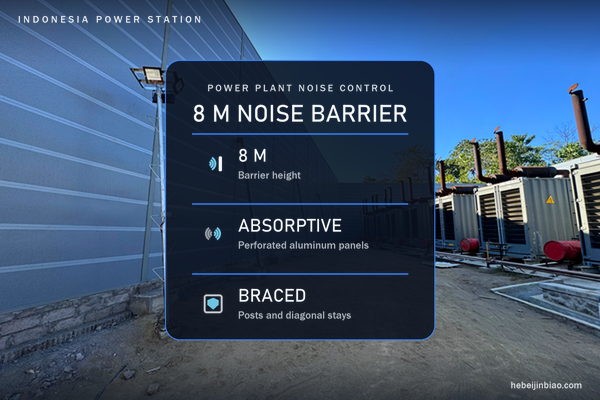
8 m Noise Barrier for an Indonesian Power Station
8 m Noise Barrier for an Indonesian Power Station
In this project in Indonesia, an 8 m high power station noise barrier was installed to shield the surrounding area from the noise of the generating units. JINBIAO supplied the noise barrier panels, posts and bracing for the barrier line. This case study explains the site conditions, the structure of the power station noise barrier and how it was built while the plant remained in operation.
Project Overview
| Item | Details |
|---|---|
| Country | Indonesia |
| Application | Power station noise control |
| Barrier height | 8 m |
| Panel type | Perforated aluminum sound-absorbing panels |
| Supporting structure | Galvanized steel posts with diagonal stays |
| Base | Masonry base wall on concrete footings |
| Scope of supply | Noise barrier panels, posts, bracing and fittings |
Project Background
The plant stands in a tropical region, with the generating units arranged in rows of containerized enclosures. Each unit produces continuous noise from engines, cooling fans and exhaust systems. Because the equipment sits relatively close to the site boundary, sound pressure levels at the fence line can rise to a point where they affect the surrounding environment. The plant therefore required a power station noise barrier that could be built close to live equipment, stand 8 m high and remain in service for many years in a hot and humid climate.
Requirements and Site Constraints
Height. The generating units and exhaust stacks are tall, so a low wall would leave a direct line of sight between the noise source and the receiving area. An 8 m barrier height was specified to intercept the sound path above the equipment.
Limited space. The power station noise barrier runs along a narrow working corridor beside the units, where cable trays, pipework and lighting poles were already installed. Panel sizes and post spacing were set so that both installation and future maintenance remain possible.
Wind load. A barrier of this height behaves like a large plate against the wind, so the posts required a stiffer support system than a conventional fence, including diagonal stays anchored to concrete footings.
Climate. High humidity, heavy rainfall and strong sun are normal in this region, so all steel components needed a corrosion protection system suited to long-term outdoor service.
Continuity of operation. The units could not be shut down for the works, so installation had to be carried out in sections alongside running equipment.
Solution Supplied by JINBIAO
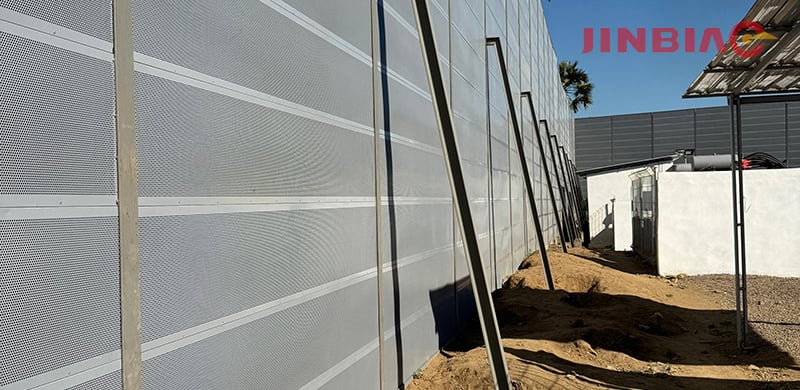
JINBIAO supplied the power station noise barrier system for the project, comprising panels, steel posts, diagonal bracing and connecting fittings.
Perforated aluminum sound-absorbing panels. The main body of the barrier is formed by perforated aluminum panels with an acoustic infill. The perforated facing allows sound energy to enter the panel, where it is absorbed rather than reflected back into the plant. This absorptive behaviour is useful at power stations, where equipment stands between parallel walls and reflected sound can otherwise build up. The noise barrier panels are arranged in horizontal modules, forming a continuous face between the posts.
Galvanized steel posts and diagonal stays. The noise barrier panels are carried by galvanized steel posts set on concrete footings. Because the wall is 8 m high, each post is supported by a diagonal stay that transfers wind load down to a separate footing. This arrangement keeps the power station noise barrier stable while limiting the size of the post section.
Masonry base wall. A block masonry base wall runs along the bottom of the barrier. It lifts the metal panels above ground level, protects the lower panels from ground water and from accidental impact in the service corridor, and provides a clean line at the base of the wall.
Corrosion protection. Steel parts are hot-dip galvanized with a coated finish on visible surfaces. Fasteners and brackets are supplied in galvanized or stainless steel, and cut edges are treated during production, which supports long service in a humid tropical environment.
Design Details at 8 m Height
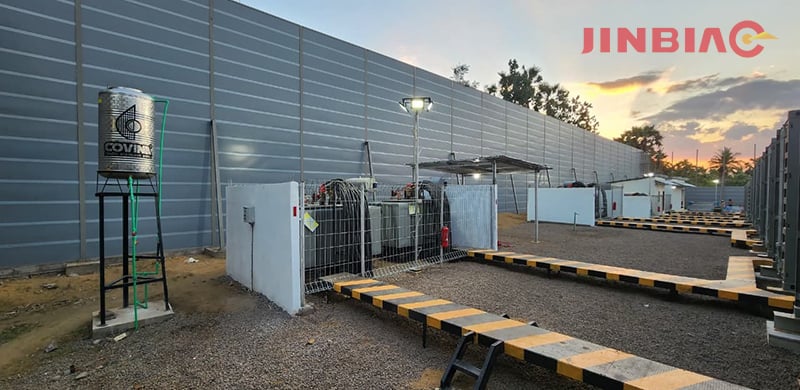
Height changes the engineering of a power station noise barrier more than any other dimension. At 8 m, wind pressure on the barrier face creates a substantial bending moment at the base of every post. Two measures were used to manage it: the diagonal stays described above, and a post spacing that keeps the load carried by each foundation within a practical size. Panel-to-post connections were detailed so that panels are held firmly but can still be replaced individually if required.
The barrier was also coordinated with existing site services. Where lighting poles, cable trays and pipework cross the barrier line, the panel layout was adjusted so that these elements pass through without cutting structural members. Drainage at the base was kept clear so that rainwater does not collect against the panels.
Installation at an Operating Plant
Because the plant remained in operation throughout the works, the power station noise barrier was installed in a sequence rather than as a single operation. Footings and the masonry base wall were completed first along each section. Posts and diagonal stays were then positioned and fixed, followed by lifting and fixing of the panels. Working from one completed section to the next kept a clear access route along the equipment corridor at all times.
Delivery was arranged in batches matched to the installation sequence, which limited the material stored on site in an area where space is scarce.
Results
The completed power station noise barrier forms a continuous 8 m high wall along the equipment corridor. Noise at the site boundary has been reduced compared with the pre-installation condition, and the absorptive panels help limit the build-up of reflected sound inside the plant. Access to the generating units is maintained, the barrier follows the existing site layout, and the galvanized and coated finish suits the local climate.
For plants with similar conditions – tall equipment, a boundary close to the noise source and a humid climate – this type of barrier offers a practical way to combine acoustic performance with durability and service access.
FAQ
Why does a power station need an 8 m high noise barrier?
Barrier height is normally set by the geometry of the site. When generating units and exhaust stacks are tall, or when the noise source sits close to the boundary, a low wall leaves a clear line of sight for sound to travel over it. Raising the barrier to 8 m intercepts a larger part of that path. The required height is confirmed by an acoustic assessment of the site.
Which noise barrier panels are used for power plant noise control?
Power plant projects commonly use perforated metal sound-absorbing panels, in aluminum or galvanized steel, with acoustic infill behind the perforated facing. Absorptive panels are often preferred where equipment stands between parallel barrier lines, because they reduce reflected energy instead of sending it back into the plant. Transparent panels can be added where daylight or sightlines must be maintained.
How is an 8 m noise barrier stabilised against wind?
Tall barriers rely on several measures together: steel posts on concrete footings, diagonal stays that transfer wind load to separate anchors, a post spacing matched to the calculated wind pressure, and panel fixings that hold each panel firmly to the post. The right combination depends on local wind speed, barrier height and ground conditions.
How are noise barrier panels protected in humid tropical climates?
Steel components are hot-dip galvanized and can be further protected with a powder or PVC coating. Fasteners and brackets are supplied in galvanized or stainless steel, and cut edges are treated during production to limit early corrosion. A masonry base wall keeps panels clear of standing water. Periodic inspection of the coating and prompt touch-up of damaged areas help extend service life.
Can a power station noise barrier be installed while the plant is running?
Yes, in many cases. The barrier is installed in sections, following the available access route along the equipment corridor, and delivery batches are matched to the installation sequence. Footings, base wall, posts and panels are completed step by step, which allows the plant to continue operating while the works proceed.
Planning a Power Station Noise Barrier?
If you are planning a power station noise barrier for a power plant, gas engine station, substation or energy storage site, send us the site layout, the height requirement and the equipment arrangement. A preliminary solution and quotation are provided at the enquiry stage, and installation drawings and technical documents are provided after cooperation is confirmed.