
 EN

Thailand Railway Project: How Perimeter Fencing Supports a Modernising Rail Network
Thailand Railway Project: How Perimeter Fencing Supports a Modernising Rail Network
Rail projects are usually described by their track, stations and signalling. The perimeter is rarely mentioned, yet it is the layer that decides who and what can reach the corridor. Hebei Jinbiao's Thailand railway project is a case in point: 6 km of railway fence at 2.5 m along key rail corridors, intended to keep unauthorised access out and to protect both passengers and wildlife.
What the project covers
According to the project record, the scope is the supply and installation of durable, corrosion-resistant fencing along key railway corridors, covering a total length of 6 km with a fence height of 2.5 m. The stated objectives are threefold: prevent unauthorised access, reduce accidents, and protect passengers and wildlife. The work sits within Thailand's wider programme of modernising its transport network.
Six kilometres at 2.5 m is a useful combination to look at, because the two figures describe different things. The length sets the commercial frame: material volume, post spacing multiplied out over the run, transport and installation logistics, and the number of possession windows the crew will need. The height sets the security frame: 2.5 m sits at the taller end of what is typical for a rail boundary, so it is usually specified where the requirement is to resist climbing rather than simply mark the boundary.
What the record still does not state is the panel type, the coating class, the project year and the client. Those are the details a buyer should ask for directly, because a railway fence enquiry without them cannot be priced accurately by anyone.
What the installed system looks like
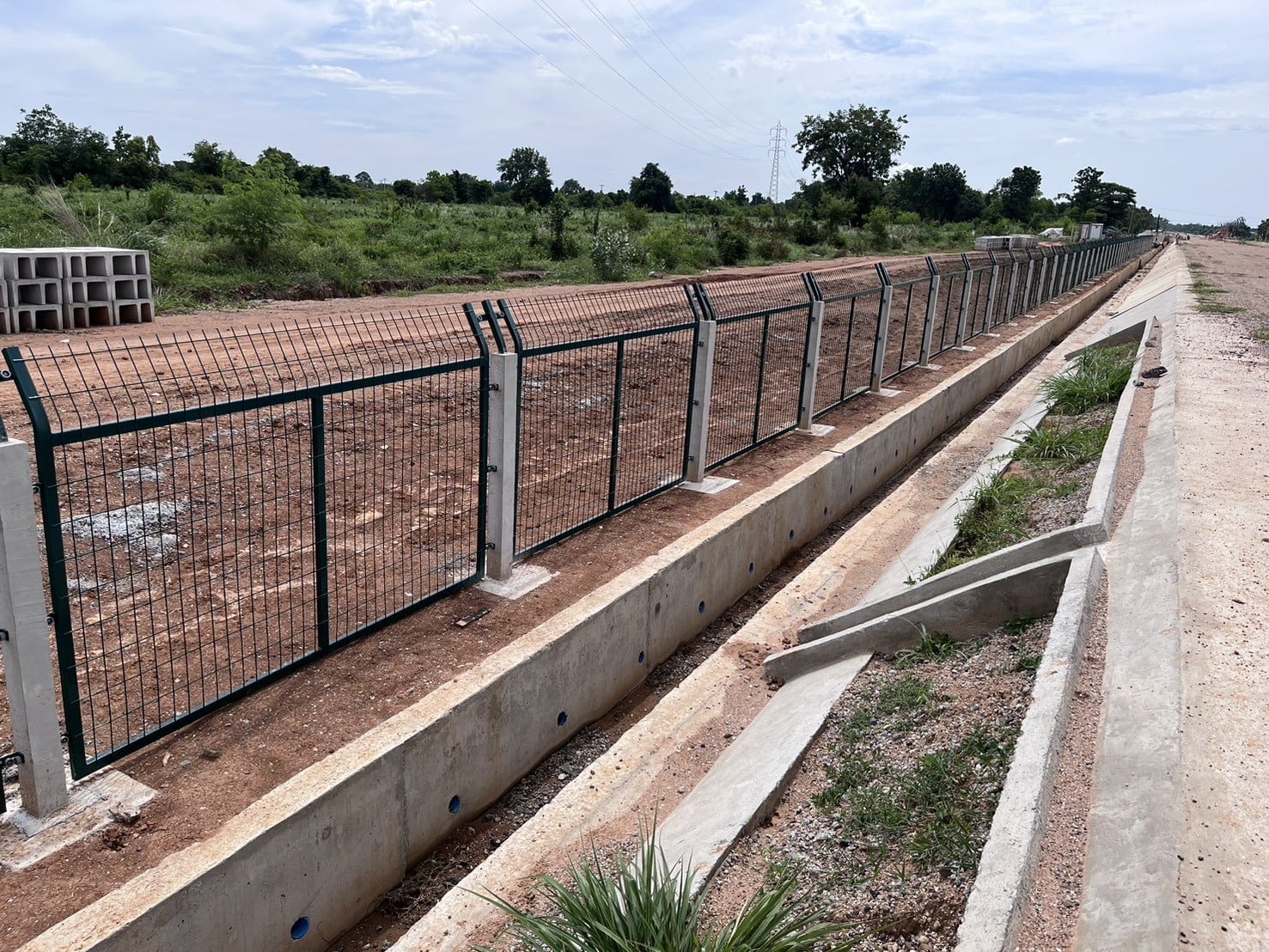
The system used on this project is welded wire mesh rather than chain link. The panels are green coated, formed from welded mesh with rectangular apertures and a curved top edge, and fixed between square concrete posts. Those posts stand on the upstand of a concrete retaining wall, with a formed drainage channel running along the outside face of that wall.
Three details of that arrangement are worth carrying into a similar package:
• Concrete posts rather than steel — there is no coating to damage at the base and no steel-to-concrete junction to protect, and the post can be dimensioned to suit the upstand instead of being bolted through it
• A coated mesh panel — the green finish is partly a corrosion measure and partly a visual one, since the railway fence is seen from the train and from adjacent land over its whole length
• The wall and the fence are one detail — the retaining wall carries the fence, so the wall's line, level and capacity govern the alignment. Any error in the wall is inherited by 6 km of railway fence
Why a rail corridor needs its own fence specification
A railway fence is not a boundary marker. It performs several jobs at once, and each pulls the specification in a different direction:
• Trespass control — keeping people and livestock off the track, particularly where the alignment passes close to settlements
• Cable and asset protection — signalling and power cable theft is a recurring cost on rail networks, and it is opportunistic, so the fence has to make access slow rather than merely inconvenient
• Wildlife separation — on sections crossing habitat or migration routes, fence alignment and crossing points matter as much as fence height
• Clearance protection — keeping the structure envelope free of obstructions, vegetation and stored material
• Maintenance access — the fence has to let the operator in at defined points without creating gaps elsewhere
A railway fence that is specified only for boundary marking will usually fail on one of the middle three within a few years.
Fence types that suit a rail corridor
Railway fencing generally comes from a small family of systems, and the choice follows the risk profile of each section rather than a single network-wide standard:
• Welded mesh panels on steel or concrete posts — rigid, consistent line, quick to install; well suited to long straight sections where a tidy appearance matters
• Chain link — a widely used railway fence in many markets, because it follows undulating ground and is economical over long distances
• 358 anti-climb mesh — small apertures with no foothold, used where cable theft or repeated intrusion is the dominant risk, and at depots, substations and signalling cabinets
• V-bend or 3D panels — stiffer panels that hold a straight top line over long runs and read as a deliberate boundary
Rail schemes usually end up with a mix: a long run of one system, upgraded locally at depots, bridges, level crossings and equipment compounds. Where the Thailand railway fence package allocates each type is exactly the kind of detail a case record should eventually publish, because it is what other projects learn from.
Corrosion is the design driver in a tropical climate
Thailand's humidity, monsoon rainfall and coastal exposure put the coating system ahead of almost everything else. A railway fence is expected to stay in service for a long time with minimal attention, so the questions that matter at specification stage are:
• Is the wire hot-dip galvanised before any additional coating, or is the coating carrying the corrosion protection alone?
• Are cut ends, weld points and post tops sealed, or will they be the first rust points?
• Are fasteners and post caps of a grade that will not galvanically attack the mesh?
• Does the coating specification match the exposure category of the actual site, rather than a generic national default?
These details are invisible at handover and decisive five years later. They are also the part of a railway fence quotation that is frequently left vague.
Working beside a live railway
Installing fence along an operating corridor is a scheduling problem before it is a construction one. Work usually has to fit inside possession windows, which favours panel systems that can be erected quickly and in short lengths, and foundations that do not need long concrete curing before the next window.
Three interfaces tend to cause delay: the drainage regime at the fence line, the position of signalling and power ducts that run parallel to the track, and the gates and access points that the operator needs during the works. A railway fence design that is complete on paper can still stop on site at any of those three.
What the Thailand project signals
Southeast Asia is investing heavily in rail, and fencing is part of that investment rather than an afterthought — it is the element that makes an operating corridor controllable. For buyers in the region, the useful questions to carry into the next tender are the ones this record leaves open: panel type, coating class, and how the 6 km splits between long-run fencing and the higher-security sections.
If you are planning a railway fence package, send the alignment length, the terrain type and the risk sections, and we can work through the specification with you.