
 EN
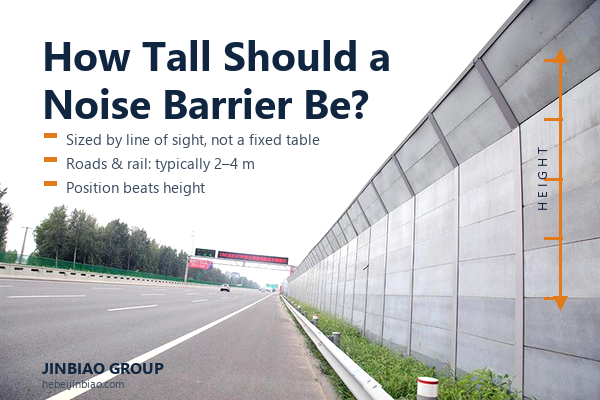
Barrier height is the first number many projects want settled, and the one that is often guessed. It is tempting to assume that a taller noise barrier performs better in every situation. In practice, height works together with the position of the barrier, the distance to the receiver and the frequency of the noise, and past a certain point each extra metre buys very little. This guide sets out how height is actually decided.
The Short Answer on Noise Barrier Height
A noise barrier should be tall enough to break the direct line of sight between the noise source and the receiver, plus a margin for the frequencies and the receiver height that matter. On many road and rail projects that lands between 2 m and 4 m above the nearest trafficable surface, with industrial and multi-storey sites running higher. The precise figure comes from a noise barrier design calculation, not from a table.
Two rules of thumb are worth carrying into that calculation:
- If the barrier does not break the line of sight, it is acoustically a fence, and the noise barrier effect will be modest.
- Once the line of sight is broken, additional height helps — but with steadily diminishing returns.
How Noise Barrier Height Reduces Noise: Diffraction
Sound does not travel only in straight lines. When a wave meets the top edge of a noise barrier, part of the energy bends over it and continues downwards into the area behind. This bending is called diffraction, and it is the mechanism that makes a barrier work.
Diffraction depends on the difference between the direct path from source to receiver and the path that goes over the barrier top. A taller barrier increases that path difference, and a larger path difference means more attenuation. Because the path difference is measured against the wavelength of the sound, the same noise barrier height performs differently at low and high frequencies: high frequencies are attenuated more readily, low bass notes bend over the top more easily and are the hardest part of traffic and plant noise to control.
The Noise Barrier Line of Sight Rule
Design guidance in standard acoustics references starts from the line of sight. A barrier that just interrupts the direct line between the loudest source and the receiver is commonly credited with roughly 5 dB of insertion loss. To reach around 10 dB, the barrier normally has to stand noticeably above that line, so that the receiver is well inside the acoustic shadow.
This is why the two inputs that drive the noise barrier design are:
- Source height. Exhaust stacks, roof plant, louvres and cooling tower fans sit high, and a barrier sized for wheel noise at 0.3 m will be far too short for a fan at 6 m.
- Receiver height. A barrier designed for a single-storey house may do nothing for the first floor windows behind it. Where the receiver is elevated, height has to rise with it.
Why Noise Barrier Position Beats Height
Moving a noise barrier closer to the source or closer to the receiver often achieves more than adding a metre of height, and costs less.
- Close to the source the barrier intercepts more of the divergent sound field before it spreads.
- Close to the receiver the shadow zone is smaller, so a shorter barrier can still cover the windows that matter.
- On embankments an existing gradient can be used as free height, provided the barrier line is stable and access is acceptable.
A useful check: if a noise barrier at the property line needs 5 m, ask whether the same panel line at the kerb would work at 3 m. On long corridors the answer is frequently yes.
Typical Noise Barrier Heights by Application
- Local roads and residential frontages: 2 m to 3 m, often combined with an acoustic fence design where space is tight.
- Highways and motorways: 3 m to 4 m for the main run, with local increases opposite upper-floor windows and where the alignment opens up.
- Railways: 2 m to 4 m, with height following track-side access requirements and maintenance clearances.
- Industrial plant: 3 m to 6 m, driven by equipment height rather than traffic, and frequently requiring absorptive faces to control reflections between buildings.
- Cooling towers and plant rooms: height follows the fan or louvre level, and may exceed 6 m.
Where a run needs to change height, the change should be stepped rather than sloped, and the taller section should extend far enough past the receiver to avoid flanking sound around the end of the wall.
Diminishing Returns
The relationship between height and performance is not linear, and this is a useful fact in budget discussions. The first metres, which break the line of sight, deliver the largest gain. Each additional metre above that line adds less than the one before it, because the path difference grows more slowly and because low-frequency sound increasingly diffracts over the top regardless of height.
The practical consequence is that a very tall noise barrier is rarely the efficient answer to a stubborn noise problem. When extra height stops returning useful attenuation, better options are usually available: an absorptive top section, a change of alignment, a second barrier nearer the source, or treatment at the source itself.
Length, Gaps and Flanking
Height only works if the noise barrier is long enough. Sound travels around the ends of a short wall as if the wall were not there, so a 5 m barrier on a 20 m frontage underperforms a 3 m barrier on a 100 m frontage. Guidance commonly suggests extending the barrier a distance of roughly four times its height beyond the last receiver, subject to site constraints.
A single unsealed gap also undoes height quickly: a gateway, a missing panel or an unsealed service penetration can carry more noise than the wall removes. For a noise barrier, airtightness at the panel joints matters as much as the panel height.
Wind Load, Foundations and Cost
Height is a structural decision as well as an acoustic one. Wind load acts on the exposed area of the noise barrier, and it rises with height — roughly in proportion to the area, with an additional effect from the increase in wind speed with height near the ground.
- Post and panel sections have to grow with the height, or the post spacing has to shorten.
- Foundations grow faster than the barrier, because the overturning moment depends on the height above the base.
- Access and maintenance become harder as the wall rises, which is why very tall barriers are often split into stepped sections.
The efficient design is therefore the shortest barrier that delivers the required attenuation with an adequate margin — not the tallest available.
Frequently Asked Questions
How tall should a noise barrier be to be effective?
Tall enough to interrupt the line of sight between the dominant source and the receiver, plus a margin so the receiver sits well inside the acoustic shadow. On road and rail projects this is usually 2 m to 4 m above the trafficable surface; industrial sites are sized from the equipment height instead.
Does doubling the height double the noise reduction?
No. Insertion loss grows much more slowly than height, because it depends on the path difference over the top edge rather than on height directly. The first metres that break the line of sight give the largest benefit, and each additional metre adds less than the previous one.
Is a 2 m noise barrier ever enough?
Yes, in specific situations: a single-storey receiver close to a low source, a quiet road with a low design target, or where the barrier can be placed near the receiver so that a short wall still covers the affected windows. It is not enough where the receiver is on the first floor or above.
What else matters besides height?
Barrier length, position relative to source and receiver, panel airtightness, the presence of absorptive faces where reflections would otherwise build up, and the frequency content of the noise. A short, tall barrier with an unsealed gate will often perform worse than a long, lower one that is properly sealed.
Next Step
Send us the site layout, the source and receiver heights, and your target reduction. We will recommend a noise barrier height with the panel type, post spacing and foundation class to match, and confirm the length and stepping needed to avoid flanking. Start from the noise barrier range, or read the companion note on how many decibels highway noise barriers reduce for the expected performance figures.
Table of Contents
- The Short Answer on Noise Barrier Height
- How Noise Barrier Height Reduces Noise: Diffraction
- The Noise Barrier Line of Sight Rule
- Why Noise Barrier Position Beats Height
- Typical Noise Barrier Heights by Application
- Diminishing Returns
- Length, Gaps and Flanking
- Wind Load, Foundations and Cost
- Frequently Asked Questions
- Next Step