
 EN
EN

358 Fence vs Chain Link: Which Is Better?
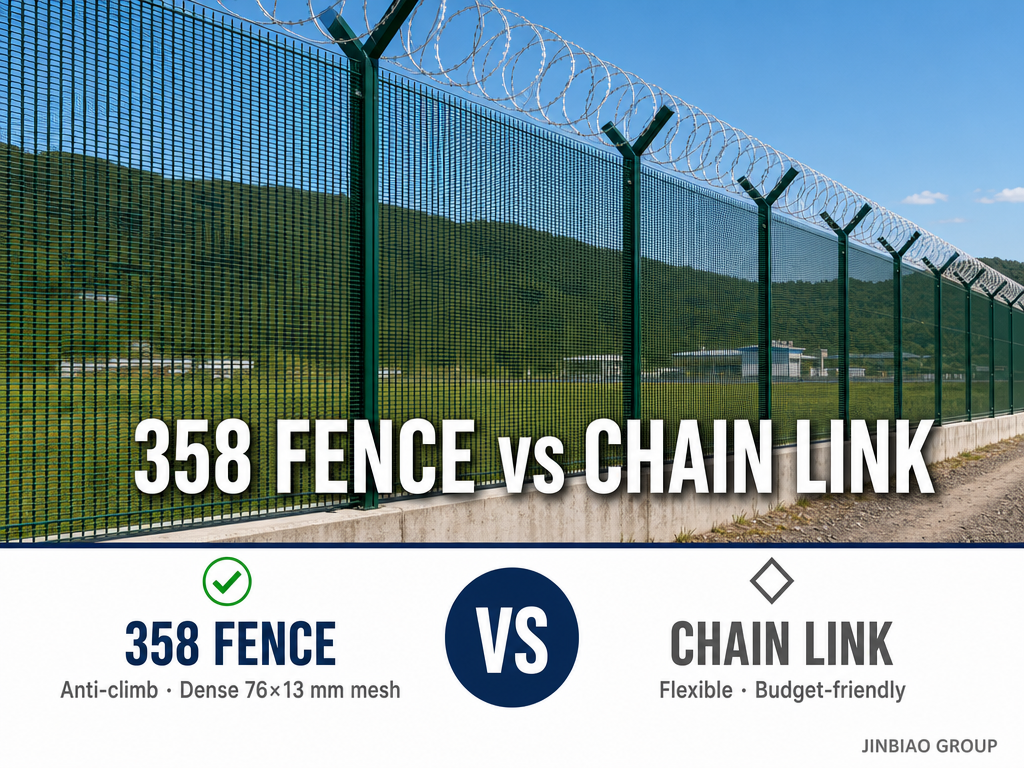
358 Fence vs Chain Link: Which Is Better?
Choosing the right perimeter fence is a key decision for any security project. Two options that are frequently compared are the 358 anti-climb fence and the chain link fence. Both provide a clear boundary with high visibility, but they serve very different risk levels. This guide compares 358 fence vs chain link on security, appearance, installation, cost and typical applications, so you can match the fence to your site.
What Is a 358 Anti-Climb Fence?
A 358 anti-climb fence is a welded mesh security fence named after its mesh opening of 3 inches by 0.5 inches (76.2 mm by 12.7 mm). The dense, narrow apertures are too small for fingers, toes or tools to grip, which makes climbing and cutting genuinely difficult. Panels are factory-welded from galvanized steel wire, usually 4.0 mm to 5.0 mm in diameter, and fixed to heavy steel posts with concealed or tamper-resistant fixings. Y-shaped posts and razor wire or concertina coil are frequently added where deterrence needs to be stronger. The result is a rigid, uniform fence system commonly specified for airports, prisons, data centres, power stations and other high-security sites.
What Is a Chain Link Fence?
A chain link fence is a woven fence made from interlocking galvanized steel wires that form a diamond mesh pattern. It is supplied in rolls and installed between posts with tension bars, ties and fittings. Because the mesh is woven rather than welded, it remains flexible and can follow uneven ground and curved boundaries easily. Chain link is widely used around the world, chosen for factories, schools, sports grounds, farms, residential communities and temporary construction sites. It offers a practical balance of cost, durability and openness.
358 Fence vs Chain Link: Key Differences
| Comparison Item | 358 Anti-Climb Fence | Chain Link Fence |
| Security level | High – designed for anti-climb and anti-cut | Moderate – climbable unless upgraded |
| Mesh opening | 76.2 mm x 12.7 mm (dense) | Diamond mesh, commonly 50-100 mm |
| Structure | Rigid welded panels | Flexible woven rolls |
| Climb resistance | Strong resistance by design | Low to medium resistance |
| Cut resistance | Higher, dense apertures limit tool access | Lower, larger apertures allow access |
| Appearance | Uniform, engineered, high-security look | Simple, utilitarian |
| Installation | Needs level runs and precise post alignment | Easy, adapts to terrain and curves |
| Relative cost | Higher initial investment | Lower initial investment |
| Typical use | Airports, prisons, power plants, borders | Schools, farms, parks, temporary sites |
Security and Deterrence
Security is where the 358 anti-climb fence clearly separates itself from chain link. The narrow apertures of a 358 fence give intruders almost nothing to grip with fingers or toes, and the welded rigid panel is harder to deform or cut than woven mesh. When installed with Y-posts and razor wire, a 358 anti-climb fence forms a formidable barrier that is very difficult to breach quickly.
A chain link fence, by comparison, offers moderate resistance on its own. The diamond mesh is easy to climb, and the larger openings allow bolt cutters to reach individual wires. For security-sensitive boundaries, chain link is usually upgraded with barbed wire or razor wire on top, and sometimes a higher grade of wire, but even then it generally remains below the protection level of a 358 fence. Both fence types keep the view through the fence open, which supports CCTV monitoring.
Visibility and Appearance
Both systems allow clear sight lines, which is why they are both popular where visibility is required. The 358 anti-climb fence has a neat, consistent appearance thanks to its uniform welded panels, and it is available in galvanized, powder coated and PVC coated finishes. Chain link has a more utilitarian look, though colour-coated versions are widely available. For projects where the fence is highly visible, such as commercial parks or public buildings, the cleaner lines of a 358 fence are often preferred from an aesthetic point of view.
Installation and Site Suitability
Chain link fence is notably quicker to install. Because it is supplied in flexible rolls, it follows slopes, curves and uneven ground without special adaptation, and repairs are simple if a section is damaged. The 358 anti-climb fence requires more careful site preparation: panels are rigid, so runs need to be level and posts accurately aligned, usually on concrete foundations. For sites with demanding security requirements, this extra installation care is a worthwhile trade-off for the stronger result.
Cost Considerations
On initial material cost, chain link fence is generally the more economical option, which is why it is so widely used for large or budget-conscious projects. A 358 anti-climb fence represents a higher initial investment because of denser mesh, heavier posts and stronger fixings. However, for high-security applications, a 358 fence may reduce the need for additional upgrades such as heavy razor wire systems, which narrows the lifetime cost gap. Actual pricing depends on specification, height, finish, quantity and delivery destination, so project owners should request a quotation with their site details for an accurate comparison.
Typical Applications
The 358 anti-climb fence is the standard choice for airports and airfields, prisons and detention centres, military and government sites, data centres, power stations, substations, border facilities and high-value industrial estates. The chain link fence remains a popular solution for schools, parks and playgrounds, sports fields, farms and livestock areas, residential communities, factory yards, railway corridors and temporary construction sites.
How to Choose Between 358 Fence and Chain Link
Ask three questions when deciding between 358 fence and chain link. First, what is the threat level? If the boundary protects people, data or assets that require serious security, a 358 anti-climb fence is the safer specification. Second, what is the terrain? If the line follows slopes or curves and security needs are moderate, chain link fence offers faster installation at lower cost. Third, what is the project budget and lifetime plan? A lower-cost chain link fence may need security upgrades later, while a 358 fence is a long-term high-security solution from day one.
Conclusion
In the 358 fence vs chain link comparison, there is no single answer that fits every project. Chain link fence is a practical, economical and flexible option for general perimeter uses, while the 358 anti-climb fence is engineered for sites where genuine anti-climb and anti-cut performance is required. If you are planning a fence project and need help choosing the right system, contact Jinbiao with your site details, security requirements and drawings, and our team will provide a recommendation and quotation based on your specific conditions.
FAQ
Can a 358 fence be climbed?
The 358 anti-climb fence is designed to resist climbing: its 76.2 mm x 12.7 mm apertures leave no footholds for hands, fingers or toes. For sites where intrusion risk is higher, Y-posts with razor wire further increase the deterrent effect.
Is chain link cheaper than 358 fence?
Generally yes on initial material cost. Chain link fence has a lower upfront price and is quicker to install. However, when security upgrades such as razor wire or heavier wire grades are added, and over the full service life, the cost difference becomes smaller.
Which fence is used at airports and prisons?
High-security sites such as airports, prisons and power stations usually specify the 358 anti-climb fence, often combined with Y-posts and concertina razor wire, because it provides a level of anti-climb and anti-cut resistance that standard chain link cannot offer on its own.