

Composite Noise Barrier on Bridge is a specially engineered soundproofing system designed for installation on bridges, viaducts, and elevated roadways. By combining sound-absorbing panels, sound-insulating layers, and optional transparent materials, it effectively reduces traffic noise while meeting the strict structural and safety requirements of bridge environments.
This solution not only minimizes noise pollution for surrounding residential and urban areas but also enhances the overall appearance and functionality of modern bridge infrastructure.

With the continuous expansion of urban transportation networks and the acceleration of urbanization, noise pollution along bridges and elevated roads has become an increasingly serious issue.
For existing bridge structures, adding effective sound insulation systems under constraints such as limited space and structural load capacity has become one of the key challenges in infrastructure upgrading.
The Composite Noise Barrier on Bridge is a professional acoustic solution specifically designed to address these challenges.
It features a multi-layer composite structure, integrating sound absorption and sound insulation into one system. This design not only significantly reduces traffic noise impacting nearby residential and urban areas, but also fully meets the requirements for lightweight construction, structural safety, and long-term durability on bridges.
The composite noise barrier on bridge adopts an innovative multi-layer structure, typically consisting of three main components:
This composite configuration enables both sound absorption and sound insulation, delivering significantly better performance compared to traditional single-material barriers.
This bridge noise barrier system is suitable for various infrastructure projects:
| Application Type | Key Characteristics |
| Urban Viaducts | Limited space, high aesthetic requirements |
| High-Speed Railway Bridges | speeds ≥ 320 km/h, high aerodynamic loads |
| Highway Overpasses | Retrofit projects, cantilever reinforcement needed |
| Scenic Area Bridges | Balance between transparency & noise reduction |
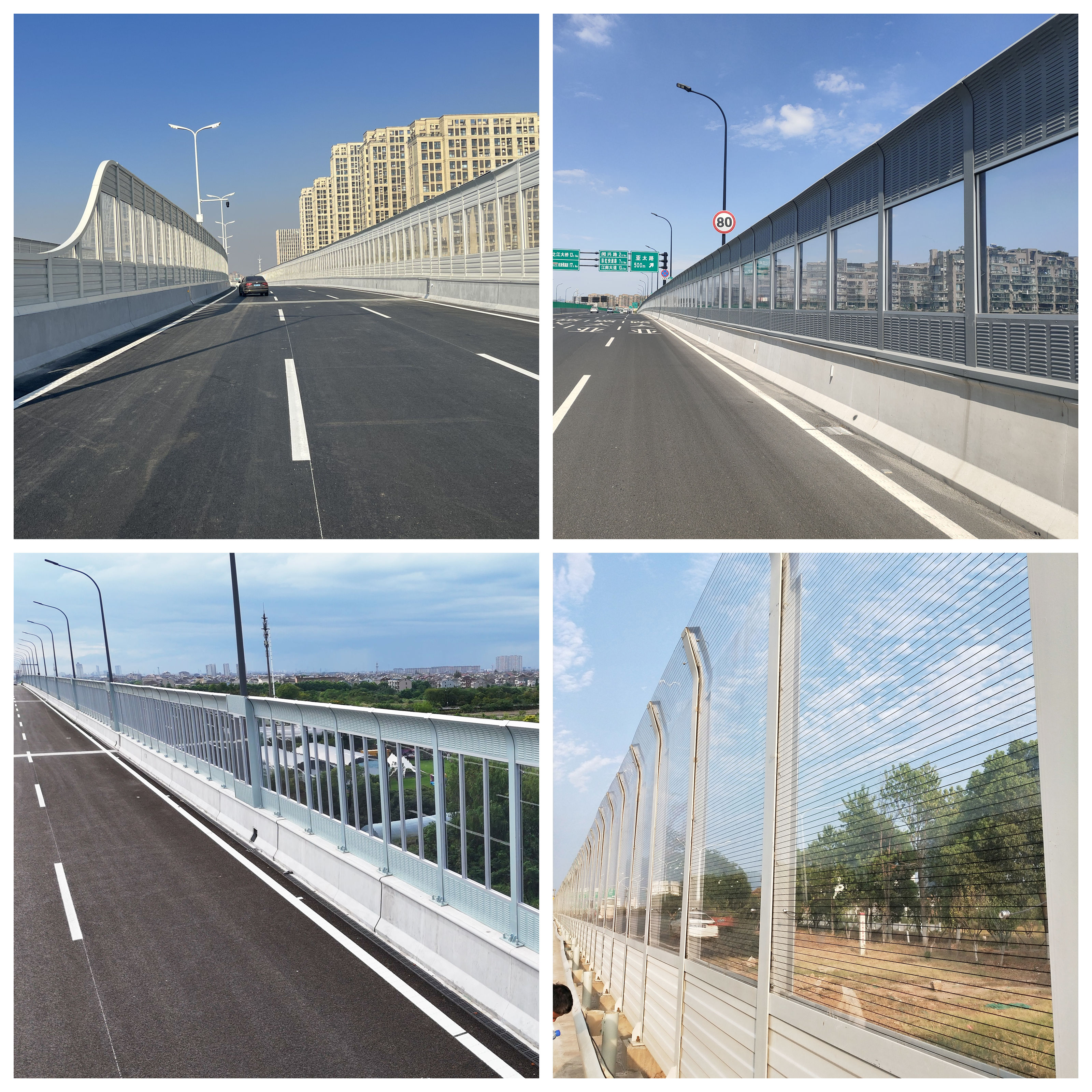
A bridge barrier has to work within limited space and a limited structural load. The composite design combines sound-absorbing and sound-insulating layers in one panel, so the required acoustic performance is reached with less weight than a single heavy material. This suits viaducts and elevated roads, where any additional load has to be kept under control.
The panel is layered: a perforated facing allows sound into the absorptive core, an acoustic insulation layer follows, and a back panel in galvanized steel or aluminium provides structural strength together with further sound insulation. Transparent PC or PMMA sections can be included in the upper rows where light and visibility are required.
In many cases yes. Load capacity and available space usually set the limits on existing structures, so the design starts from the permitted load per metre and the fixing positions available on the parapet. Panels are then selected within those limits, and the base connections and fixing details are designed accordingly.
They are used on road and railway bridges, viaducts, elevated urban expressways and flyovers, as well as on bridge sections that pass close to housing. Where a bridge continues into an enclosed section, the same panel system can be carried through to form a partial or full enclosure.
Useful inputs are the bridge or parapet drawings, the permitted additional load, the barrier length and required height, the noise target and the site wind conditions. A preliminary solution and quotation are provided at the enquiry stage; acoustic design and installation drawings follow once the specification is confirmed.


 EN
EN